
After wet grinding, extraction or preparation of a suspension, a practical question arises for the researcher: how to quickly and reproducibly separate the solid phase from the liquid and remove the supernatant without losing the fine fraction. The settling in the rack for micrometer range particles is too slow and poorly controlled: the result depends on temperature, convection and random shocks. A desktop mini-centrifuge solves this problem differently - it creates a controlled centrifugal field in which the sedimentation rate increases by orders of magnitude.
However, the mini-centrifuge does not replace other laboratory instruments. It does not crush material, does not mix powders and does not work instead of a grinding glass. Its function is narrow: phase separation by density and accelerated sedimentation of solid particles. Understanding this boundary determines which characteristics of the device are truly important and which are secondary.
Challenge: Separate a phase without losing the sample
In laboratory practice, centrifugation is usually necessary for one of four actions: to obtain a clarified supernatant, to obtain a compact sediment, to wash the sediment with fresh medium, or to divide the suspension into fractions according to sedimentation rate. Each action has different requirements. For clarification, the complete removal of the fine fraction from the liquid is important; for obtaining a precipitate, its density and ability to return to suspension is important; for washing, the ability to carefully remove the liquid without loss of solid material; for fractionation, the repeatable duration of the cycle is important.
A common mistake is to treat these tasks as one. A device that clarifies liquid well does not necessarily produce a sediment convenient for further work, and vice versa. Therefore, the selection of a model and mode begins not with the rotation speed, but with the formulation of what should be obtained in a test tube.
It is worth distinguishing between three related concepts: the volume of one test tube, the total volume of the rotor and the actual workload. The working load is almost always less than the nominal volume of the test tube: part of the volume is left free so that the liquid does not splash out and contaminate the rotor. If the request specifies only the sample volume, the selection is carried out blindly.
How does in vitro separation work and where are the model boundaries?
Sedimentation in a centrifugal field
Centrifugation speeds up the process, which under normal conditions occurs under the influence of gravity. The particle moves to the bottom or wall of the test tube because its density differs from the density of the medium. The speed of movement of a spherical particle in a dilute suspension is proportional to the square of its diameter, the difference in the densities of the particle and the liquid, and inversely proportional to the viscosity of the medium. In a centrifugal field, instead of the acceleration of gravity, this ratio includes centrifugal acceleration, which can exceed g by hundreds and thousands of times.
This has three practical consequences. The larger the particle, the faster it settles, and the dependence is quadratic: the difference between fractions of 1 and 10 microns is very large. The greater the difference in density between the particle and the liquid, the faster the separation. The viscosity of the medium works against the speed, so the separation of the fine fraction in a thick suspension requires either more time or more acceleration.
Centrifugal acceleration is usually expressed not in absolute units, but in terms of relative centrifugal acceleration (RCF), measured in units of g. RCF is directly proportional to the radius of rotation and the square of the rotation speed. Hence the rule of thumb: doubling the rotational speed quadruples the acceleration, but increasing the radius gives only a linear increase. It is incorrect to compare devices based on the same rotation speed without indicating the rotor radius.
Sedimentation, filtration and centrifugation are not the same thing
Settlement does not require a device, but is poorly controlled: the time for complete clarification depends on the height of the liquid column and temperature, and the fine fraction may not settle at all. Filtration quickly retains large particles, but introduces a filter material into the sample that is capable of sorbing components and clogging; Some of the liquid remains in the sediment. Centrifugation does not add foreign material to the sample, works with small volumes and is easily scaled by the number of tubes.
Centrifugation has its own limitations. It separates phases by density, but does not separate solutes. Particles of the same density settle together at any acceleration. If the task is to separate the fine fraction from the large one, you do not need a maximum mode, but a strictly maintained time and a selected environment: a cycle that is too long will drag the fine fraction into the sediment.
What Limits Predictability
Calculation using the Stokes ratio provides a guideline, not a guarantee. The model assumes spherical particles, dilute suspension, laminar motion, and no interaction between particles. Real powders consist of irregularly shaped particles, often aggregated; at high concentrations, the particles interfere with each other, and sedimentation slows down compared to calculation. The walls of the test tube and convective currents also distort the picture.
The practical conclusion is simple: calculation helps to select the range, but the final mode is selected by a trial run on real material. It is necessary to record not only the rotation speed, but also the radius of the rotor, the type of test tube, sample volume, temperature and cycle time - otherwise the result cannot be reproduced either after a week or in another laboratory.
Tabletop mini centrifuge TENCAN: design and its role in sample preparation
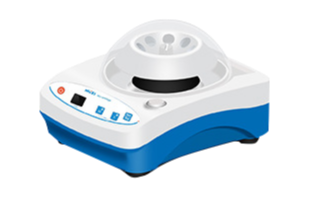
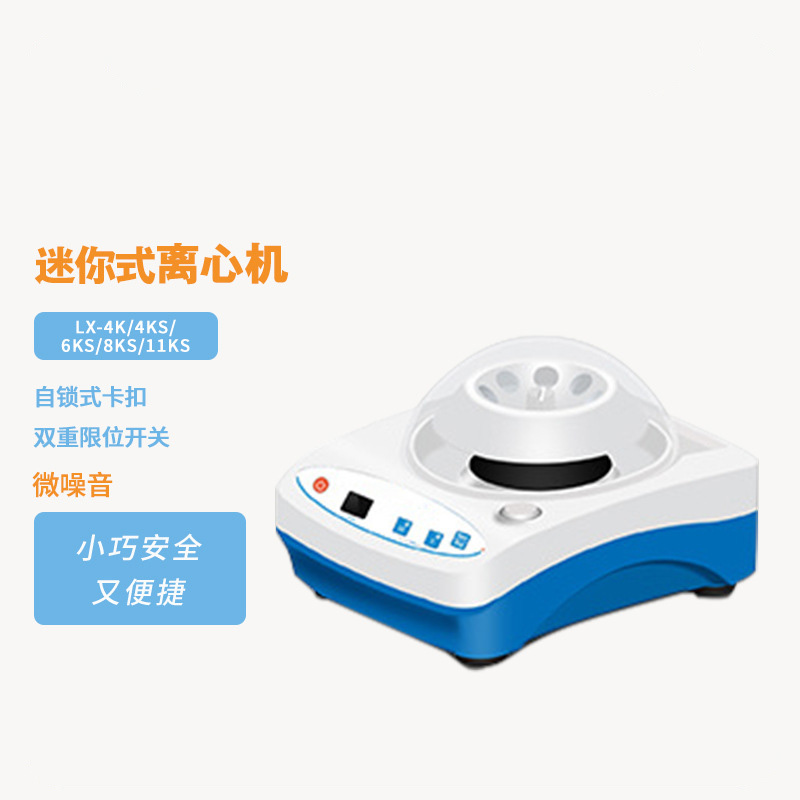
Mini centrifuge TENCAN — compact desktop device from the laboratory equipment section. Specific characteristics of the model (format and number of seats, rotation speed range, permissible radius, available rotors and adapters) are given in the product card and manual; It is impossible to transfer the parameters of one modification to the entire range. Below we explain what these characteristics mean and how they relate to the result of the separation.
Rotor: angular or swinging
In an angular rotor, the test tubes are fixed at an angle to the axis of rotation. The path of the particle to the wall is shorter, sedimentation is faster, and the sediment falls on the side wall and in the corner of the test tube. This sediment is denser and less susceptible to re-suspension, but the cycle is shorter. This is convenient for routine lightening and obtaining a dense precipitate.
In a swinging (bucket) rotor, the test tubes take a horizontal position during acceleration, and the particles move strictly along the axis of the test tube. The sediment collects at the bottom in an even layer, making it easier to remove and easier to return to suspension. This option is preferable when careful handling of the sediment is important or when separation occurs along a density gradient. The price for this is a longer deposition path and, as a rule, longer cycle times for the same acceleration.
Drive, balancing and cover
The drive of the tabletop centrifuge is an electric motor with electronic speed control. For reproducibility, what is more important is not the maximum number, but the stability of maintaining a given mode and the repeatability of acceleration and deceleration from cycle to cycle. If the device “floats” according to the actual rotation speed, the deposition time has to be increased with a margin.
The test tubes in the rotor must be balanced in mass and arranged symmetrically. Even a slight imbalance causes vibration, accelerated bearing wear and the risk of tube damage. The locking lid is not a formality: it holds the aerosol and fragments when the test tube is destroyed, so you cannot open the device until the rotor has completely stopped.
Test tubes and adapters
The tube format must match the rotor seat; adapters allow the use of tubes of a different diameter, but do not change the rotor geometry and do not increase the permissible acceleration. Each tube has its own RCF limit specified by the manufacturer. If the test tube limit is lower than the device mode, destruction will occur in the test tube and not in the rotor.
Separately check the tightness of the lids. For samples prone to aerosol formation and for aggressive media, test tubes with a sealing cap are used; however, the chemical resistance of the lid and body is assessed separately as materials may vary.
How to read characteristics: acceleration, k-factor, volume, time
RCF and rotor radius
Rotation speed in revolutions per minute is a convenient but incomplete characteristic. The result of deposition is determined by the acceleration at the radius where the sample is located, and it depends on both the rotation speed and the geometry of the rotor. Two devices with the same speed, but different radii, will give different acceleration and different results. Therefore, in the sample preparation protocol it is reasonable to record RCF, and not just revolutions.
k-factor
k-factor is a conditional indicator of the rotor, inversely proportional to the square of the rotation speed and depending on the geometry: the smaller it is, the faster, other things being equal, the sedimentation of particles occurs at a given sedimentation rate. This is a convenient way to compare two rotors with each other, but is not an absolute guarantee of the result for a particular suspension.
Volume, loading and sample weight
The nominal volume of the test tube, the total capacity of the rotor and the mass of the dry sample are different values, and they cannot be mixed in the calculation. The mass of the loaded material affects the density and viscosity of the suspension, and therefore the sedimentation rate: overloading the tube with the solid phase slows down the separation and increases the load on the rotor.
Cycle time and braking mode
The total cycle time consists of acceleration, operation at a given mode and braking. Sharp braking creates vortex flows in the test tube, which stir up the already formed sediment, therefore, for soft and loose sediments and for separation in a gradient, a slow stop is used. For heavy precipitation, fast braking is acceptable and saves time.
Tube Materials, Solvents, and Contaminant Transfer
Polymers and glass
Polypropylene tubes are resistant to most aqueous solutions and acids, can withstand autoclaving and are convenient for routine work. Polycarbonate tubes are transparent and mechanically strong, but are less resistant to alkaline environments, some solvents, and autoclaving. Polystyrene is transparent but brittle and has limited chemical resistance. Glass is chemically inert, but at high accelerations the risk of destruction is higher, so its use requires separate verification.
For aggressive solvents, test tubes made of resistant polymers or metal are used; The specific compatibility of the tube material and the medium is checked using chemical resistance reference tables and the manufacturer's instructions. There is no universal material suitable for all environments and modes.
Wear, cleaning and cross-contamination
Test tubes and adapters are consumable items. Microcracks, cloudiness, and traces of previous samples accumulate and become a source of cross-contamination, especially when working with microelements. Washing, drying and storing tubes in closed containers is part of the technique, not a secondary procedure.
It is useful to distinguish between a centrifuge and grinding equipment: they are different classes of devices. For example, corundum grinding glass designed for a planetary mill and is not installed in a centrifuge rotor. The material of such a glass is corundum, aluminum oxide; It is characterized by high hardness and wear resistance, but with intensive grinding it introduces its own particles into the sample. If the suspension is obtained by wet grinding in a corundum beaker, some of the aluminum oxide may appear in the precipitate after centrifugation and affect the result of the composition analysis.
Heat, aerosols and safety
A running rotor heats the air in the chamber and the sample itself. In benchtop instruments without a cooling system, the temperature of the contents of the tube may differ markedly from the temperature in the laboratory, and this is important for thermolabile samples. A distinction should be made between chamber ventilation, forced air cooling and cooling by a refrigeration unit. Conventional air cooling is not a cryogenic process; the opposite can be stated only if there is a confirmed cryogenic option.
The temperature of the working space of the installation is not equal to the measured temperature of the sample. The difference is determined by engine heat generation, aerodynamic heating, sample volume and cycle time. For sensitive samples, it makes sense to pre-cool tubes and reduce cycle times rather than relying on chamber sensor readings.
The second risk factor is aerosol. When the tube is destroyed or the lids are open, some of the liquid is sprayed inside the chamber. Hence the requirements: close the lids of the test tubes, use sealed options for dangerous samples, wait until the rotor stops completely, inspect the rotor for signs of corrosion and damage. Taking into account these rules relates to the methodology, and not to the configuration of the device.
Common mistakes, scaling and data for the supplier
Errors during selection and work
The most common mistakes: comparing devices by revolutions without taking into account the radius; overloading of the tube, due to which the separation is slower than expected; working with imbalances; use of test tubes whose acceleration limit is lower than the device mode; transfer of a typical minimum particle size from a catalog to any real sample. None of the catalog indicators guarantees results for a specific suspension.
Another mistake is the lack of recording of conditions. If RCF, time, temperature, medium and tube type are not recorded, repeating the cycle becomes a guessing game and comparison of runs becomes impossible.
From a single sample to a series
When moving from one tube to a series, it is not the physics of separation that changes, but the organization of work: the number of cycles, time for loading and unloading, stability of the regime from cycle to cycle. Increasing the number of seats improves performance, but does not replace mode selection. For serial work, it is useful to determine in advance which parameters remain constant and which can be adjusted along the way.
Connection with previous processing steps
The result of centrifugation depends on how the suspension is prepared. The degree of grinding, the ratio of solid phase to liquid, the introduction of a surfactant or stabilizer, the temperature of the medium - all this affects the aggregation of particles and, consequently, the deposition rate. Grinding and separation are sequential, but different operations: the mill changes the particle size, the centrifuge separates the already prepared suspension by density and size.
Information for selection and trial run
To select the mini-centrifuge configuration TENCAN and separation mode, the supplier is usually given: the nature and density of the solid phase, the initial particle size, the type and viscosity of the liquid medium, the volume of one sample and the required number of samples in a series, the desired result (clarified liquid, dense sediment, washing), temperature limitations, chemical aggressiveness of the medium and documentation requirements. This data allows us to suggest a rotor, tube type and indicative RCF range for the trial run.
Frequently asked questions
Is it possible to compare two mini-centrifuges based on the same rotation speed?
No. At the same rpm, acceleration at the sample radius depends on the rotor geometry, so a correct comparison is made by RCF, and not by rpm.
Does maximum acceleration produce maximum separation purity?
Not necessarily. Excessive acceleration and a long cycle drag the fine fraction into the sediment, and too dense sediment is more difficult to return to suspension. The mode is selected according to the task, and not according to the principle “the more, the better.”
Is it possible to cool the sample using conventional air cooling of the instrument?
Ventilating the chamber reduces heat, but does not make the device cool. For thermolabile samples, the actual heating of the sample is taken into account and, if necessary, the cycle time is adjusted or the tubes are pre-cooled.
Is a centrifuge a substitute for a grinding bowl or mill?
No. The grinding bowl and grinding media are grinding equipment, and the centrifuge is phase separation equipment. These are different devices with different functions, and the consumables of one are not used in the other.
Selection criteria: brief summary
Selecting a tabletop mini-centrifuge begins with the result you want to obtain and the properties of the suspension, and not with the maximum number on the control panel. Next, the format of the tubes and their acceleration limit, rotor type, RCF range taking into account the radius, cycle time and braking mode, temperature limits and chemical compatibility of materials are sequentially specified.
All specific values - rotation speed, number of seats, volumes, permissible modes - are taken from the product card and instruction manual. Calculation allows you to narrow the range, but the final confirmation comes from a test run on real material with a record of conditions. This approach makes the results reproducible and separates informed hardware choices from promises that cannot be verified.