
Selecting a grinding bowl is often perceived as a secondary task compared to selecting a planetary mill. However, it is the material of the glass, its geometry and condition that directly affect the purity of the sample, the reproducibility of grinding and the wear of the grinding media. Agate grinding glass TENCAN — one of the options that is used to prepare samples that are sensitive to metal contamination. In this article, we look at in what cases agate is justified, what limitations it has, and what needs to be checked before ordering and trial grinding. TENCAN — brand of Changsha Tianchuang Powder Technology Co., Ltd.; A general list of destinations can be found at main page of the site.
Why is an agate glass chosen for planetary grinding?
A planetary ball mill works by rotating the grinding bowl around its own axis and around a common axis. The grinding bodies inside the glass experience impact and abrasion loads, which depend on the centrifugal acceleration, the size and mass of the balls, the filling of the glass and the properties of the sample. Under such conditions, the beaker material is in constant contact with the moving balls and powder. If the beaker is not hard enough or is prone to brittle fracture, its surface will wear away and particles of the beaker material will be introduced into the sample. This is especially critical when analyzing trace amounts of elements, when preparing samples for spectral methods, and when working with materials where the introduction of metals is prohibited.
Agate in this context is considered to be a material with relatively high hardness and a low tendency to react chemically with most samples. It contains no free metals and may therefore be preferable to steel cups if iron, chromium or nickel are to be avoided. However, agate is a natural mineral, and its behavior depends on the specific stone sample, the presence of inclusions, cracks and the quality of processing. Therefore, we cannot talk about agate as a universal material that is suitable for any task and guarantees “zero pollution.”
Choosing a glass begins with the question: what exactly happens to the sample. If the task is to roughly grind hard and abrasive material down to tens of micrometers, agate can quickly wear out. When careful preparation of a soft, brittle or moderately hard sample is required with minimal risk of metal contamination, agate beaker is a reasonable candidate. Between these extremes there are many intermediate cases, and the decision is made on a combination of factors, and not just on the name of the material.
Separately, it is worth mentioning the role of the glass in reproducibility. Two samples of the same material, crushed in beakers of different materials, may yield different particle size distributions and different chemical compositions. This is due not only to hardness, but also to the shape of the inner surface, roughness, manufacturing accuracy and condition after previous grinding. Therefore, when switching to another glass or another batch of consumables, it is useful to carry out a control grinding and compare the result with the standard. If the laboratory operates using a standardized procedure, changing the beaker may require revalidation.
Agate material: advantages and limitations
Agate is a type of chalcedony, a fine-fibered quartz based on silicon dioxide SiO₂. This nature determines its key properties: high hardness (usually around 6.5–7 on the Mohs scale), brittleness, low electrical conductivity and chemical resistance to most acids except hydrofluoric acid. In laboratory practice, this means that the agate beaker is capable of working with non-abrasive and moderately abrasive powders for long periods of time, but it is not indestructible. Shock loads, large solids and improper mill operation can cause chips, cracks and accelerated wear.
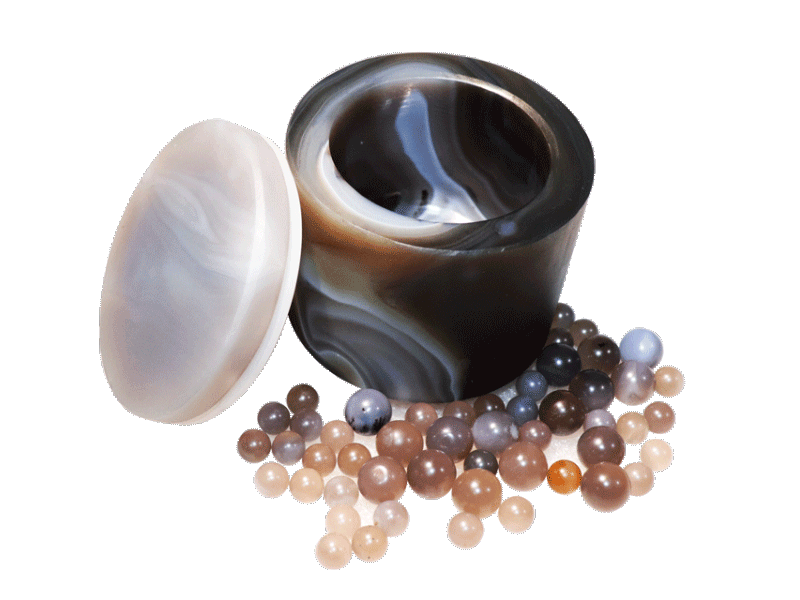
It is important to distinguish between natural agate and synthetic materials, which are sometimes called “agate” in everyday life. TENCAN supplies precisely agate grinding glasses made from a natural mineral. This means that each batch may vary slightly in color, pattern and distribution of micro-inclusions. Such differences usually do not affect functionality, but require careful initial inspection: before first use, you should inspect the internal surface for cracks, chips and foreign inclusions.
Agate's limitations aren't just about wear and tear. Agate is sensitive to sudden temperature changes: if a glass after wet grinding with cooling is immediately placed in a hot dryer, thermal cracking may occur. It is also not recommended to use strong alkalis and hydrofluoric acid, which can dissolve the quartz matrix. Neutral or slightly alkaline detergents, alcohols and an ultrasonic bath with moderate power, but without abrasive powders and hard brushes, are suitable for cleaning.
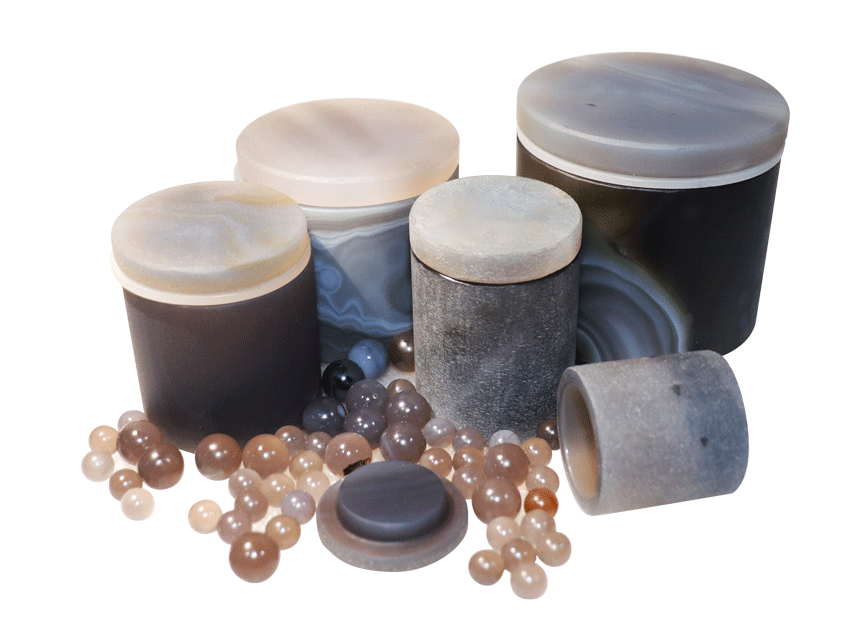
The quality of an agate glass is as important as the material itself. The inner surface should be smooth, without visible shells, cracks or inclusions. The edges must not be chipped. The lid should fit tightly and the seal should provide a tight seal when rotating. If the glass is supplied with grinding media, they are also inspected. When ordering, you should specify what agate the glass is made of, what the wall thickness is and what sizes are available. These parameters affect weight, strength and thermal conditions. In the product card Agate grinding bowl for planetary mill available options are shown; these must be matched to the mill's requirements.
Compatibility of agate glass with planetary mill
The grinding bowl is a consumable item that must match the specific mill model. It cannot be assumed that any agate glass will fit any planetary mill. Compatibility is determined by several parameters: seat dimensions, fixation method, outer diameter and height of the cup, wall and lid thickness, as well as permissible load weight. The mill manufacturer specifies these limits in the manual. If the glass does not match the geometry, it may not lock in place, begin to break, overheat, or collapse during rotation.
The product card “Agate grinding bowl for planetary mill” shows the available options. Before ordering, you must check them with the passport of your mill. If there is insufficient information, you should ask the supplier for exact fitting dimensions and recommendations on acceptable modes. You should not select a glass “by eye” or focus only on volume: two glasses of the same nominal volume can have different heights and diameters.
Separately, we note that a laboratory centrifuge, for example mini high speed centrifuge TENCAN, is not a grinding equipment and cannot be used instead of a planetary grinding mill. The centrifuge solves the problems of phase separation, sedimentation and preparation of suspensions. These are different classes of devices and cannot be interchanged. If solids need to be separated from liquid after wet grinding, centrifugation may be a separate step, but does not influence the choice of grinding bowl.
What to check first
- Bore diameter and height of the cup.
- Fixation method: clamping cover, threaded connection, clamp.
- Presence and condition of sealing rings.
- Permissible load weight specified by the mill manufacturer.
- The maximum rotation speed at which the glass is allowed to be used.
These points seem obvious, but it is a discrepancy on one of them that most often leads to the fact that the glass does not fit. For example, the glass may fit into the socket, but the lid does not fit tightly enough, and a leak appears at high speeds. Or the outer diameter coincides, but the height turns out to be greater than permissible, which is why the mill does not close. Therefore, checking the geometry is the first step, not the last.
Pollution and Wear: What to Expect from Agate
Sample contamination during grinding comes from several sources: beaker material, grinding media material, remnants of previous samples, atmospheric dust and wear products. Agate does not contain metals, so the risk of introducing Fe, Cr, Ni, Co is significantly lower than with steel glasses. However, this does not mean that pollution is completely absent. When worn, the agate glass releases SiO₂ particles into the sample. If the sample itself contains silicon or if the analysis is silicon-biased, such a contribution may be noticeable. For particularly clean applications, it is sometimes preferable to use a beaker made of a different material or to use special control techniques.
Wear on agate manifests itself in different ways. In the initial period, slight lightening of the inner surface in areas of contact with the balls may be observed. Over time, matte spots, microchips and changes in geometry appear. Cracks, chips on the edges and damage to the cover are considered critical. If the glass has a crack, its further use is dangerous: when rotating at high speed, it can break. Therefore, before each grinding, a visual inspection is recommended, and after grinding, cleaning and checking for new defects.
The wear rate depends on the hardness of the sample, the size and density of the grinding media, the rotation speed, the duration of grinding and the filling of the glass. Abrasive materials such as oxides, carbides, quartz sand accelerate wear. Soft and fragile samples, on the contrary, have less impact on the walls. To reduce wear, use grinding media made of agate or other soft material, reduce the grinding speed and time, and also avoid overloading the glass with large balls. However, each of these steps affects the grinding efficiency, so a compromise is required.
Wear mechanisms of agate glass
Wear of agate occurs through several mechanisms. Abrasive wear is associated with the scratching action of hard particles and balls. Impact wear occurs at high speeds and a large mass of grinding media, when the balls hit the walls. Fatigue wear accumulates over repeated load cycles, leading to microcracks. Chemical wear is possible upon contact with aggressive media, especially hydrofluoric acid and concentrated alkalis. In real work, these mechanisms act together. Understanding the predominant mechanism helps to adjust the regime: reduce the speed, reduce the size of the balls, change the grinding time, or choose a different glass material if the agate does not withstand the conditions.
Dry and wet grinding in an agate glass
Dry grinding in an agate beaker is used for samples that do not stick together and do not require a liquid medium. The advantages are simplicity, no additional drying step and less risk of chemical interaction with the solvent. Disadvantages: dust formation, sticking to the walls and ball, as well as a higher impact load on the glass material. When dry grinding, agate can wear out faster due to the lack of lubricating and cooling fluid. In addition, small particles tend to agglomerate, making it difficult to obtain a narrow particle size distribution.
Wet grinding involves adding liquid: water, alcohol, acetone or other suitable solvent. The fluid reduces friction, removes heat and reduces dust. For an agate glass, it is important to choose a chemically compatible liquid. Water and aqueous solutions of neutral salts are usually safe, but prolonged contact with strong alkalis is undesirable. Organic solvents such as ethanol or isopropanol are also widely used, but require compliance with fire safety regulations. After wet grinding, the glass must be thoroughly rinsed and dried so that residual liquid does not affect the next sample.
Regardless of the method, you should not fill the glass to the brim. Free volume is necessary for the movement of grinding media. Typical practice is to leave at least a third of the volume unfilled, but exact recommendations vary depending on the mill model and application. Overfilling leads to the fact that the balls do not have time to accelerate, the grinding slows down, and the load on the walls increases. Loading too little is also ineffective: wear increases due to direct impacts of the balls on the walls.
Fluid selection and drying
The liquid for wet grinding should not only reduce friction, but also not interact with the beaker material and the sample. Water is convenient but may cause some samples to corrode or hydrolyze. Alcohols wet powders well and evaporate quickly, but are flammable. Acetone is effective for degreasing, but is aggressive towards some polymers. For each case, a solvent is selected that does not dissolve the sample and does not destroy the agate. After grinding, drying should be gradual: first in air, then in a closet at moderate temperature. Rapid evaporation in a hot cabinet can cause the agate to crack, especially if the glass has been cooled.
Cleaning, storage and condition monitoring
A clean grinding bowl is essential for reproducibility. Between samples, it is necessary to remove sample residues, dust and wear debris. The cleaning procedure usually includes several steps. First, remove the bulk of the powder with a dry soft brush or vacuum cleaner with a filter. The glass is then washed with a suitable solvent or detergent. Concentrated alkalis and hydrofluoric acid are not recommended for agate. After washing, the glass is rinsed with distilled water or pure solvent and dried in air or in an oven at moderate temperature. Sudden heating after cold washing is not advisable due to the risk of thermal cracking.
If the laboratory is analyzing trace elements, a more stringent protocol may be required: acid etching with a weak solution, repeated rinsing, monitoring the purity of the solvent. In such cases, it is better to assign the agate beaker to a specific group of samples to avoid cross-contamination. Storage is carried out closed, in a dry place, protected from shock and dust. Do not stack glasses without spacers: the edges may touch and chip.
Condition inspection includes inspection of the inside surface, edges and cover. Microcracks can be seen under oblique lighting. If chips or cracks appear, the glass is taken out of service. You should also check the sealing elements of the lid: a worn seal leads to powder leakage and a leak. For precise work, it is useful to keep a log: date, sample, mode, condition of the glass. This helps to notice accelerated wear in time and associate it with specific conditions.
Control cleanliness and prevent cross-contamination
For trace analysis, it is important not only to clean the glass, but also to confirm cleanliness. Sometimes, after washing, a control blank grinding is performed without a sample and the resulting dust is analyzed. If elements are found in it that should not be there, the cleaning procedure is reviewed. It is useful to use separate beakers for different classes of materials, especially if the laboratory is analyzing geological, metallurgical and polymer samples. Labeling glasses and keeping a log helps prevent accidental mixing. You should not store beakers open in an area where sample preparation of other materials is carried out: dust may settle on the inner walls.
Selection of volume, grinding media and transition to a larger batch
When choosing an agate glass, volume is not the only parameter. It is necessary to consider how much sample is required for analysis, what the bulk density and initial particle size are, and what final particle size needs to be achieved. For laboratory samples, a small beaker is often sufficient, but if the sample is heterogeneous, a small sample may not be representative. On the other hand, increasing the volume of the glass requires more grinding media and can change the energy intensity of grinding. Therefore, the selection is based on the task: first, the required sample mass and the target distribution of particles are determined, then the glass and mode are selected.
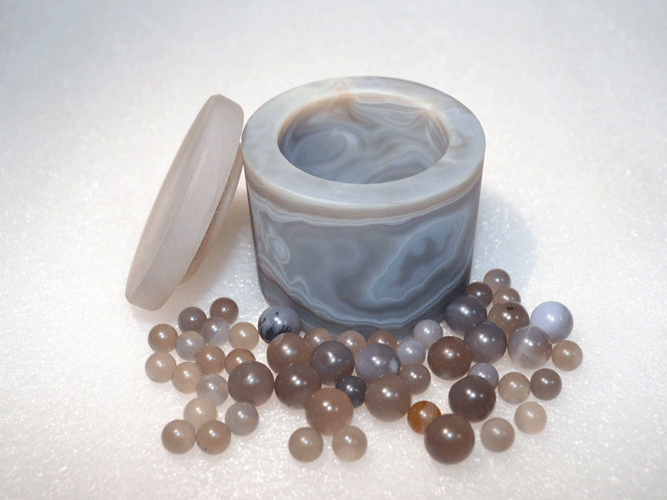
Grinding media for agate glass are usually made of agate to avoid heterogeneous contamination. However, agate balls also wear out and can chip. Their size is selected depending on the initial size of the sample and the desired final size. Larger balls are more effective at breaking up large particles but leave a wider distribution. Smaller balls produce a finer grind, but take longer and may stick. The number of balls and their total mass must correspond to the volume of the glass and the power of the mill. Exceeding the permissible load weight can lead to overload of the drive and accelerated wear of the cup.
Moving from a laboratory sample to a larger batch is a separate task. If a small-volume agate beaker was used in the laboratory, mechanical transfer of the regime to a large beaker does not always give the same result. The diameter, path of the balls, and energy distribution change. To scale up, a series of trial grindings are carried out and the particle size distribution is compared. If large volumes are required, sometimes they switch to glasses made of other materials, such as zirconium dioxide or tungsten carbide, but this changes the contamination profile. The decision is made taking into account the acceptable contribution of impurities and economic feasibility.
Relationship between grinding media and sample
One of the key parameters is the ratio of the mass of the grinding media and the mass of the sample. Too few balls do not provide effective grinding, too many - increases wear on the bowl and the risk of overloading. For agate glasses, which are less durable than steel glasses, it is recommended to stick to conservative regimes. The exact ratio depends on the material, initial grit and target size. It is better to select it experimentally, starting with moderate values and gradually increasing the grinding energy. At the same time, monitor the temperature of the glass and the condition of the inner surface. If heating or microchips appear, the mode is adjusted.
What to tell before trial grinding and ordering
To select an agate grinding bowl and mode, the supplier or process specialist needs to provide information about the task. It is useful to indicate the model of the planetary mill, the year of manufacture and the mounting dimensions of the socket. If a mill has not yet been selected, first determine the equipment class, and then compatible consumables. The sample is described below: material, hardness, initial particle size, bulk density, required mass and target particle size. It is important to specify which elements cannot be added to the sample and how strict the purity requirements are. They also inform you whether dry or wet grinding is planned, what solvent is planned to be used and what temperatures are permissible during drying.
Based on these data, it is possible to suggest bowl volume, material and size of grinding media, loading ratio and preliminary rotation parameters. Test grinding allows you to check whether the desired coarseness is achieved and whether there is overheating, sticking or unwanted wear. After trial grinding, the particle size distribution and, if necessary, chemical composition are analyzed for contamination. Only after this does it make sense to move on to regular work. You should not order a glass based solely on appearance or price: incompatibility in geometry or material can lead to equipment damage and loss of samples.
Below is a short list of information that should be prepared before contacting the supplier or before trial grinding:
- Model and mounting dimensions of the planetary mill.
- Sample material, its hardness and initial size.
- Required sample mass and target particle size.
- Acceptable and unacceptable impurities.
- Suggested grinding method: dry or wet.
- Solvent and drying temperature.
- Available grinding time and heating limits.
- Requirements for cleaning and storing the glass.
This information allows you to reduce the number of trial iterations and quickly select a compatible glass. If some data is unknown, they are clarified during preliminary tests.
Agate grinding glass TENCAN — This is a specialized tool for planetary grinding, which requires careful attention to the conditions of use. It helps reduce the risk of metal contamination, but does not eliminate wear, cleaning and compatibility testing. If the application involves particularly hard or abrasive materials, large volumes, or stringent silica trace requirements, a different cup material may be required. In any case, the solution should be tested experimentally and not based only on general statements.