
Eight Position Roller Mill TENCAN attracts laboratories that need to prepare several samples in parallel. Eight work positions looks like a simple multiplication of capacity, but in practice the result depends on what glasses are allowed, how the load is distributed, how fast the rollers rotate and how the heat is controlled. Product card — Eight Position Roller Mill — serves as a starting point; Specific configuration parameters must be checked with documentation and checked with the supplier, and not inferred from the name.
What does eight-position layout mean in practice?
The working position is where the grinding bowl is placed on the rollers. Eight positions means the unit can accommodate multiple cups, but does not reveal whether each position has a separate drive, whether different speeds or programs can be set, or whether the load capacity is the same. These issues are resolved by a specific design. If all rollers are connected to a common drive, the speed is usually common; if independent units are provided, this must be expressly stated in the description. The name "eight-position" does not in itself prove either independence or synchronicity.
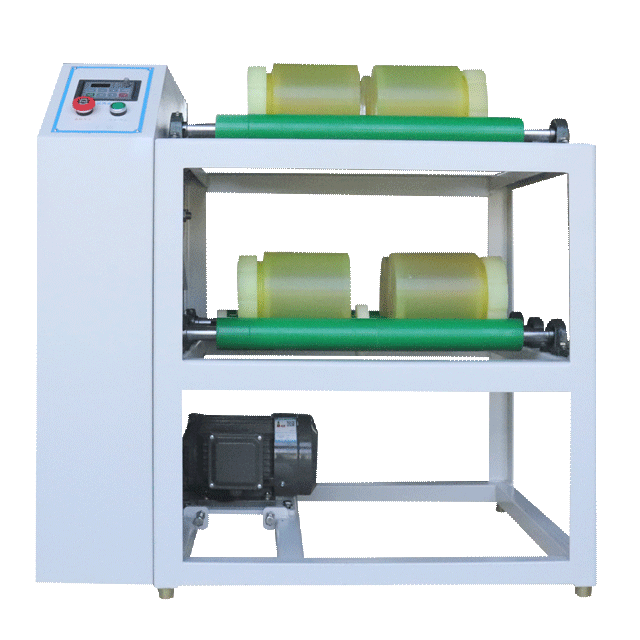
The roller principle differs from the planetary principle. In a planetary ball mill, the glasses rotate around a common axis and at the same time around their own, due to which complex accelerations arise. In a roller mill, the glass rests on rotating rollers and rotates due to friction. Inside the glass, the grinding bodies rise and fall, crushing the material through impact and abrasion. This arrangement may be convenient for laboratory testing, mixing and fine grinding, but its energy and nature of action are not identical to a planetary mill, bead mill or roller crusher.
Eight positions are useful for parallel samples, blank runs and reproducibility control. However, parallelism does not guarantee identity: glasses may differ in geometry, weight and surface condition; rollers - wear and alignment; loading - distribution of powder. Therefore, when moving from one sample to a series, it is worth checking how much the result depends on the position. To do this, the same sample is processed in several positions and not only the grinding time is compared, but also the particle size distribution, yield and the presence of impurities.
Finally, the number of positions is not equal to the number of simultaneously processed samples for any glass. Eight places can be occupied only by those glasses that are allowed in diameter, length, weight and method of fastening. If the glass is too large or heavy, some positions may be inaccessible and the mode may be limited. This is the first thing you need to clarify before planning a series.
How spinning a glass turns into grinding
The rollers transmit rotation to the glass through friction. If the glass slips, the actual rotation speed is lower than the set one, and the result is less reproducible. Therefore, not only the readings of the regulator are important, but also the condition of the surface of the rollers, the cleanliness of the glass, the weight of the load and the reliability of the clamp. In installations with multiple positions, it is worth checking separately whether slippage occurs at different positions with the same setting.
Inside the glass, the grinding bodies first rise along the wall, then break off and fall. At low speeds, rolling and abrasion predominate; at higher values, the role of impacts increases. Above a certain level, bodies can press against the wall and stop making useful impacts. This transition depends on the diameter of the glass, the size and density of the grinding media, filling and properties of the powder. Therefore, there is no universal “correct” speed for a roller mill.
Why RPM cannot be transferred from one glass to another
The rotation speed expressed in rpm does not fully characterize the mode. The linear speed on the inner wall depends on the diameter of the glass: at the same rpm, a glass with a larger diameter imparts a different speed to the grinding media. The length of the glass, the shape of the lining, and the weight of the headset also have an effect. If the documentation indicates a rotation speed range, it still needs to be correlated with the permissible glasses and their diameter. It is impossible to transfer the mode from a planetary mill or from a roller installation of a different geometry without testing.
Dry and wet grinding: different tasks and limitations
During dry grinding, the powder can agglomerate, generate dust and stick to the walls and grinding media. This does not always mean that grinding is not progressing: the measurement may show large aggregates, although the primary particles have already been crushed. Wet grinding often improves solids distribution and reduces dusting, but introduces liquid which changes viscosity, sedimentation, washing and drying. In addition, the liquid must be compatible with the material of the beaker, grinding media and sample.
Wet grinding does not automatically guarantee a finer result. In some systems it accelerates deagglomeration, in others it interferes with impacts due to the viscous medium. The choice between dry and wet mode is determined by the material, cleanliness requirements, permissible humidity and method of measuring particle size. Mixing multiple powders is also not the same as grinding: soft mode may distribute the components, but not grind them.
Loading: what to count and what not to confuse
When selecting a mode, it is important to separate the nominal volume of the glass, the useful working volume, the volume of grinding media, the mass of the sample and the productivity of the installation over time. Nominal volume is a geometric characteristic; it does not mean that the glass can be completely filled with powder. The workload is always smaller, since part of the space is taken up by the grinding media, and the powder needs room to move. Productivity depends on the cycle time, the permissible weight per position and the number of glasses used simultaneously.
Too much sample mass can dampen impacts and slow down grinding. Too low a mass reduces the likelihood of contact between particles and grinding media, and the result becomes sensitive to losses and heterogeneity. Excess grinding media increases wear, noise and heat, but does not necessarily produce finer powder. Specific limits should follow the manual and trial grinding results; You cannot transfer values from another mill.
For an eight-position installation, the total load is important. Even if each individual position is acceptable, operating multiple heavy cups at the same time can change the vibration, heat, and behavior of the drive. Symmetrical load distribution across positions usually helps maintain stability, but requirements vary by design. If the installation has a common drive, uneven loading may be more noticeable than with independent positions.
The material of the bowl and grinding media affects wear and the transfer of impurities. Zirconia, ceramic, tungsten carbide or stainless steel do not mean "zero contamination": the abrasive powder wears down the fitting, and the soft material can become contaminated by wear debris. It is necessary to take into account the hardness of the sample, permissible impurities, aggressiveness of the environment and the cleaning method. Washing or dry cleaning is required between samples and is available for selected materials; Residues in the corners and on the seal may skew the following result.
What parameters should I check with the card and with the supplier?
The product card helps identify the purpose of the installation and proceed to discuss the configuration, but does not replace the passport. If the value is not specified, it cannot be substituted by analogy with another model. For an eight station roller mill, it is helpful to tabulate the questions and get the answers in writing.
| Parameter | What does it define | What to clarify |
|---|---|---|
| Acceptable glasses | Diameter, length, material, weight | What glasses are allowed and how are they fixed? |
| Load per position | Weight of the beaker with grinding media and sample | Maximum for one position and for the entire installation |
| Rotational speed | Speed of rollers and cup | Range, task accuracy, influence of glass diameter |
| Drive and control | General or independent speed, timer, reverse | Which positions are managed together and which separately? |
| Rollers and fastening | Rotational stability and slippage | Material, wear, distance adjustment, cleaning |
| Safety | Access protection, emergency stop, noise | What locks are provided and how are they checked? |
| Scope of delivery | Limits of responsibility | Are glasses, grinding media, documentation and training included? |
On the main page TENCAN equipment directions are presented, but the specific equipment is still checked using the card and documentation. Anything that is not confirmed should not be considered an option: for example, independent position control, cryogenic operation, or other roller material should not be added to the description by assumption.
Overheating, noise and condition monitoring
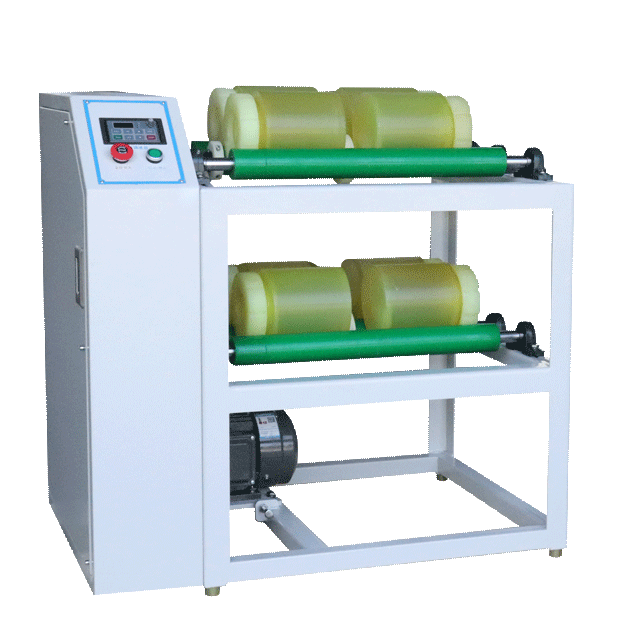
Heat sources in a roller mill are friction, drive operation and the powder processing itself. During grinding for a long time, the beaker can heat up, and so can the sample and seals. Conventional air cooling is not a cryogenic process. Unless the manufacturer confirms operation with liquid nitrogen, the unit cannot be described as cryogenic. The air temperature in the working area is also not equal to the temperature of the powder inside the glass.
For heat-sensitive materials, it is useful to provide pauses, load reductions, or separate temperature controls if provided by design. Signs of poor operation may include odor, seal deformation, unusual noise, increased vibration, and heating of the lid. When such signs appear, the process is stopped and the glass, fastening and loading are checked. You cannot continue grinding just because the timer has not yet completed.
Fully loading eight positions may increase noise and heat generation compared to operating a single cup, but this depends on weight, speed and design. The installation is placed on a stable surface, safety locks are checked, and it is not left unattended in an unfamiliar mode. If work with flammable or volatile substances is expected, safety issues are resolved separately and are not replaced by a general selection clause.
Reproducibility and serialization
Eight positions are useful for testing repeatability: the same sample can be processed in several beakers and particle size distribution, yield and purity can be compared. This does not prove that all positions are identical, but it does show how suitable the setup is for parallel samples. If the differences are large, the reasons are sought in the geometry of the glasses, the condition of the rollers, the loading weight and the installation order, and do not attribute everything to “grinding features.”
When moving from a laboratory sample to a larger series, two options are possible: increase the number of simultaneously working beakers or move to larger beakers. The first way preserves the geometry, but increases the requirements for the drive, fastening and organization of work. The second changes the diameter, linear speed, mass of grinding media and thermal conditions; the result is not automatically scaled. If the diameter of the glass changes, the previous rpm no longer describes the same mode.
It is better to set the criterion for completing grinding through the particle size distribution, and not just through time. The measurement can be performed by sieve analysis or laser diffraction; The method of sampling and dispersion affects the results. Agglomerates may appear as large particles, but after disagglomeration the picture changes. Therefore, to compare modes, it is important to maintain the same measurement methodology.
The test log should record the actual rotation speed, the diameter and material of the bowl, the mass and size of the grinding media, the mass of the sample, the ratio of dry and wet mode, time, temperature and cleaning method. These data make it possible to repeat a successful regime and explain the discrepancy, if it appears. Without them, selection turns into memorizing random numbers.
Practical checklist for trial grinding
Before testing, it is necessary to describe the material: initial size, hardness, tendency to agglomerate, permissible temperature, sensitivity to moisture and cleanliness requirements. Then determine the purpose: whether fine grinding, disagglomeration, mixing or simply parallel sample preparation is needed. The criteria will be different for each goal, and one mode does not have to solve all the problems.
- Indicate the mass of the sample per beaker and the expected number of parallel samples.
- Agree on the permissible diameter, length and material of the bowl, as well as the mass of the grinding media.
- Find out whether dry or wet grinding is allowed and what liquid is compatible with the headset.
- Check the rotation speed range and how it relates to the selected glass diameter.
- Determine whether all positions will work at the same time and whether the load is the same.
- Document cleaning method between samples and acceptable level of cross-contamination.
- Agree on the size control method and sampling procedure.
Test grinding is carried out by changing one factor at a time: load weight, number or size of grinding media, rotation speed, time. It is useful to include a control sample and test several items under the same conditions. If the installation allows for different glasses, start with the one that is closer to the planned series, and not with the largest. It is better to tie the process stop to the measured result and the state of the glass, and not just to the estimated time.
Before ordering, you should request documentation for a specific configuration, a list of acceptable bowls and grinding media, as well as safe operating conditions. Card eight position roller mill helps to start a dialogue, but the final choice is made after checking the parameters and trial grinding. Eight positions is a tool for parallel work, and not a promise of the same size for any material; The result is determined by the compatibility of the glass, load, speed and control technique.