
Preparation of a powder sample does not always begin with grinding. In laboratory and technological practice, the reverse operation is often required: from several bulk components, obtain a mixture in which the content of each component is the same at any point in the selected sample. Three-dimensional mixer TENCAN from the mixing series of equipment solves exactly this problem: it drives a closed drum with powder and does not use grinding media.
Next, we will talk about one practical issue: how to select the mode and loading of a three-dimensional mixer so that the mixture is homogeneous and the result is reproducible from batch to batch. Dry bulk materials of different sizes and densities, laboratory and aggregated samples, cross-contamination and a list of parameters that need to be recorded are considered. Diagnosis of specific installation faults is not discussed here: without test data, any statement about the cause remains conjecture.
Homogeneous dry mixture: what is considered the result
The homogeneity of a mixture is not an absolute value, but a characteristic related to the sample size and the key component. If a mixture contains 99% base and 1% additive, the suitability is determined by the content of the additive: a deviation of 0.1% absolute is almost imperceptible for the base, and 10% relative for the additive. Therefore, the criterion is formulated as the acceptable relative standard deviation, or coefficient of variation, of the content of the key component in samples taken from different places.
The second clarification is the sample size. A powder taken with a spatula from one place and an analytical sample of 0.5 g are different objects. The smaller the sample, the stronger the local heterogeneity and the higher the measured scatter for the same mixing quality. The requirement for the mixture is therefore always specified together with the selection method and sample weight.
The third clarification concerns terms. Mixing - equalizing the concentrations of components without changing the particle size. Disagglomeration is the destruction of loose aggregates held by cohesive forces. Grinding is a reduction in the size of the particles themselves. A drum mixer with spatial movement solves the first problem: it ensures the movement of the powder mass, but does not contain grinding media and is not intended for targeted particle size reduction.
Practical consequence: when mixing in such an apparatus, the granulometric composition of the components is preserved. There are no fresh surfaces from abrasion, there is no transfer of grinding media material, which means there is less risk of introducing impurities. This is important for mixtures where the particle size and shape are set by previous grinding and should not change.
Typical tasks where this mode is appropriate: preparing a charge before pressing or sintering, diluting a small additive into the main powder, averaging a laboratory batch before taking a representative sample, combining components of different natures but similar in size. A common feature is that it is the composition that is required to be equalized, and not a change in particle size.
At the same time, not every mixture can be brought to a homogeneous state in any apparatus. The limit of achievable homogeneity depends on the properties of the components more than on the operating mode: sticking fine powders and components with large differences in densities limit the result, regardless of how long the drum is running. Therefore, it makes sense to start selecting a regime with an assessment of the materials themselves.
How 3D reel movement works
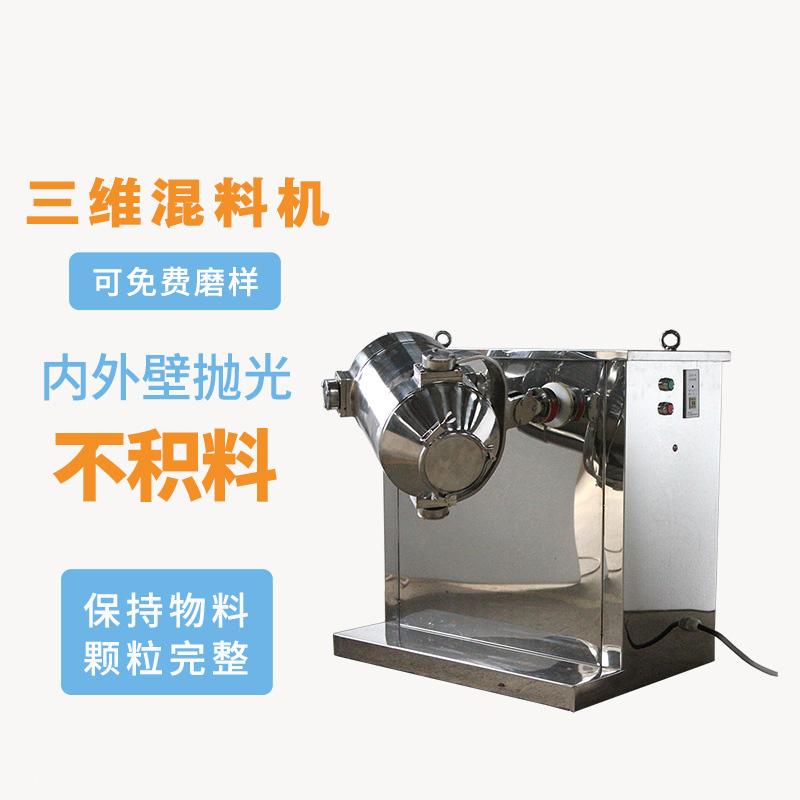
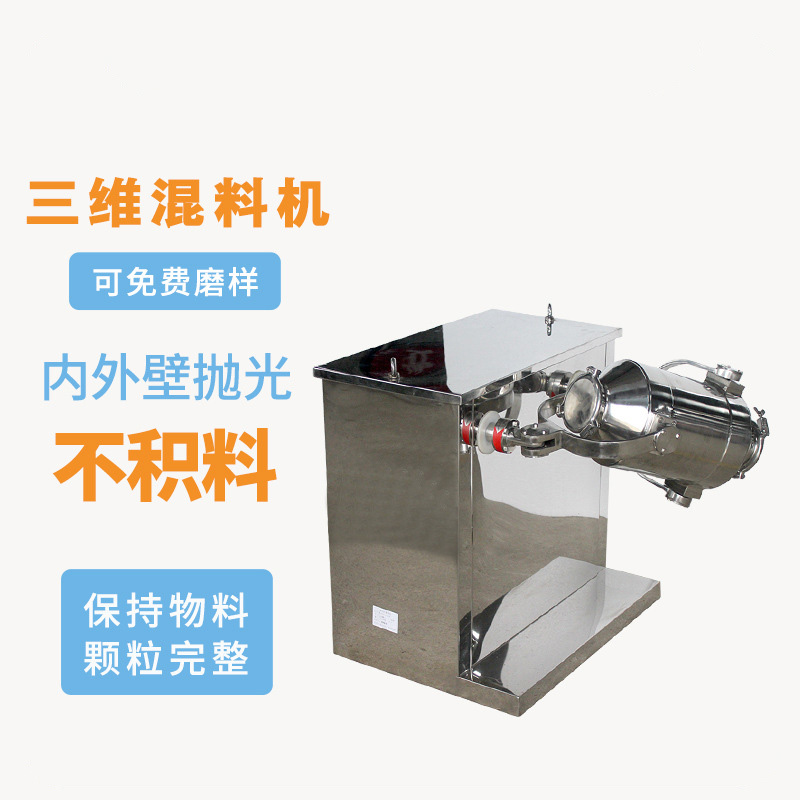
The drum of a three-dimensional mixer performs a complex movement: it rotates around its own axis and at the same time sways along with the supporting frame, so that the axis of the drum continuously changes its position in space. The trajectory of a point on the drum wall is not a flat circle, but a spatial curve; hence the name of the equipment class.
For a powder mass, this means a constant change in the orientation of the free surface. Some of the material rises along the wall and falls off, forming a convective flow; adjacent layers shift relative to each other, which gives shear mixing; at the level of individual particles there is an exchange between layers. The three mechanisms complement each other: convection quickly equalizes the composition over large zones, but slowly on the particle scale, and shear without changing the orientation of the layers leaves stagnant areas.
Rocking the axis adds an axial component to the movement. It works against stagnant zones at the ends of the drum and against stable accumulations of a component with a different density. With simple rotation around one axis, areas at the ends are often preserved where the material is almost not involved in circulation; spatial motion weakens this effect, although if loading fails it does not eliminate it completely.
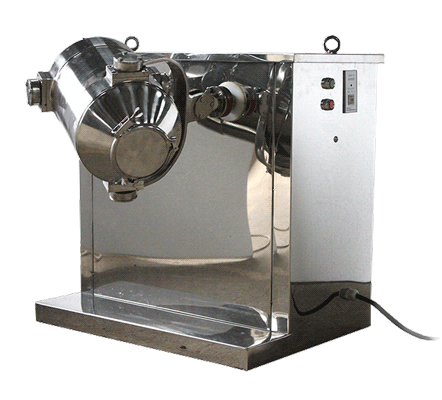
There are no blades or augers inside the working chamber: mixing occurs due to the movement of the drum itself. The energy is transmitted not through a high-speed rotor, but through moderate rotation and swing, so the impact on the particles is relatively mild. Fragile, lamellar or ready-sized materials are not further crushed or abraded to the same extent as in devices with rapidly rotating tools.
At the same time, the limitations of the class appear. The specific energy per unit mass here is small compared to high-speed mixers, so for very fine sticky powders and for the destruction of durable aggregates, one movement of the drum may not be enough. In addition, the free movement of the powder is determined by gravity: the behavior of the mixture depends on the bulk density and the angle of repose, and not just on the drive.
Sample conditions: what determines achievable homogeneity
Size, density and segregation
The most common cause of heterogeneity is differences in component particle size and density. Percolation works in a freely flowing mixture: small particles spill into the spaces between large ones and gradually accumulate in the lower layers. If the particles differ in density, trajectory segregation is added: when rolling along the surface of the layer, heavy particles travel further than light ones. Both mechanisms continue to operate even after reaching a homogeneous state - the mixture is capable of stratification with further movement.
Hence the rule of thumb: the closer the components are in size and density, the easier the uniformity is to achieve and the shorter the cycle. If there is a large difference, you have to either limit the mixing time and unload the drum immediately after reaching an acceptable indicator, or reduce segregation by other means: moistening, if this is permissible by technology, introducing a binder, changing the loading order, refusing to freely pour the finished mixture.
Load order also matters. Loading in layers is not equivalent to pre-mixing by hand: if you add a light component first and a heavy one on top, the initial stage is determined by the gravitational collapse of the layers. The loading order, as well as the time and frequency, should be recorded in the test report.
Adhesion, moisture, electrostatic charge
Fine powders with particle sizes of the order of several micrometers behave not as a bulk body, but as a coherent medium: van der Waals forces and capillary forces between particles are comparable to the weight of the particle. This mixture moves in large aggregates, but inside the aggregates the composition remains almost unchanged. Uniformity here is limited by the state of the particles, and not by the drum mode.
Free moisture increases adhesion and adhesion to the walls: some of the material remains on the wall and falls out of circulation. For hygroscopic materials, it makes sense to record the moisture content before mixing and evaluate the losses on the walls after the cycle. Drying is a separate operation and a separate class of equipment; The mixer is not designed to remove moisture, and replacing drying with prolonged mixing usually does not give the desired effect.
Dry insulating powders are charged as they move: the particles are attracted to the walls, viewing windows, and discharge unit, forming a layer that is difficult to remove. This affects uniformity, loss and purification. Grounding, sealed container loading and choice of contact surface material help, but their applicability depends on the design of the installation and the properties of the material, so such decisions are negotiated rather than taken for granted.
What do the characteristics mean: volume, load, frequency, time
Total volume, working volume, loading weight
In descriptions of mixing equipment, the word “volume” appears in several meanings, and confusion between them is the source of most selection errors. The full geometric volume of the drum is the internal capacity of the working chamber. Working volume is that part of it that can be occupied by material during normal operation. The mass of the load is no longer a volume: it is obtained by multiplying the working volume by the bulk density of the material, and it differs significantly for different powders.
Bulk density has at least two values: aerated, in a loose state, and shaken, after compaction. To calculate the load, a shaken one is usually used, and an aerated one is used to evaluate the behavior in motion. Without measuring the bulk density of a specific material, converting liters to kilograms is pointless.
Productivity is the third quantity that is often confused with volume. It is expressed by the mass of the mixture per hour and depends not only on the drum, but also on the duration of the full cycle: loading, mixing, unloading, cleaning between products. With short mixing times and a high proportion of manual operations, productivity is determined by the work organization, not the drive. It is correct to compare the mass of the mixture per cycle along with the duration of the cycle.
| Term | What does it mean | What to clarify |
|---|---|---|
| Total drum volume | Geometric capacity of the working chamber | Drum material and design, presence of lining |
| Working volume | Part of the container occupied by the material during operation | Recommended duty cycle for this design |
| Loading weight | Powder mass per cycle | Bulk density of the material - aerated and shaken |
| Number of containers | Number of reels operating simultaneously | Symmetrical and balanced loading |
| Mixing time | Drum movement duration | Time-heterogeneity curve for a given mixture |
| Performance | Mass of mixture per unit time | Complete cycle time with loading, unloading and cleaning |
Frequency, amplitude, duty cycle
The rotation frequency and swing amplitude determine how much energy is transferred to the powder mass per unit time. An increase in frequency enhances the convective flow and accelerates the equalization of the composition, but increases dusting, enhances the segregation of freely flowing mixtures, increases the wear of components and heating of the material. If the frequency is excessive, the material may press against the wall and stop mixing like a loose body; if the frequency is too low, mixing proceeds slowly and the bottom layers are poorly entrained.
The fill factor has no less effect. An overfilled drum does not leave free space for the powder to be poured: the movement degenerates into a slow movement of the mass as a whole, and the load on the drive increases. Too small a loading reduces the number of contacts between particles and makes the result sensitive to randomness. Specific recommendations for filling out relate to a specific design and are taken from the documentation for it, and are not transferred from other equipment.
Why more time doesn't mean more uniformity
Mixing follows nearly exponential kinetics: initially, the heterogeneity drops quickly, then the improvement slows down and the curve reaches a plateau. The plateau is determined by the properties of the mixture and the design, and not by the duration of operation. Further rotation of the drum does not improve the composition, but wastes time, heats the material and increases wear.
Over a long distance, reverse processes begin to predominate. Free-flowing mixtures with differences in size or density gradually segregate and the uniformity index may deteriorate from the minimum achieved. Clumping mixtures accumulate aggregates, and the fine fraction sticks to the walls. This creates a situation familiar to laboratories: increasing time does not give the expected improvement, and sometimes worsens the result.
The practical conclusion is to work not with a fixed time “according to instructions”, but with a “time - heterogeneity” curve built for a specific mixture. Plan: several cycles with different times at the same load, sampling from several points after each cycle, determining the content of the key component using one method, calculating the coefficient of variation. The minimum of the curve is the working time for a given composition; When changing a batch of raw materials, it is worth rechecking it.
It is also worth remembering that part of the heterogeneity is introduced not by the mixer, but by sampling. The sampler, spatula, or scoop may sample predominantly coarse or fine fractions, and the measured scatter will reflect the instrument rather than the mixture. Therefore, the selection method is fixed before testing begins.
Selection Tradeoffs: Containers, Materials, Cleanup, Scale
Choosing a three-dimensional mixer is more a choice of operating conditions than a single number. The following are the tradeoffs that most often determine the configuration.
Closed containers versus built-in drum. Mixing in a closed container, which is then transferred for storage or transportation, reduces dust, losses and the risk of separation when pouring. The fee is the need for reliable fastening of the container, balancing the load and restrictions on the weight and dimensions of the container. In addition, when mixing in someone else’s container, some of the material remains on its walls and is not included in the assessment of losses.
Material of contact surfaces. Stainless steel, polymer linings, ceramics - each option has its own wear profile and its own risk of introducing impurities. The polymer lining reduces the likelihood of metal penetration, but it wears out, tolerates abrasive powders less well, and has temperature limitations. No material provides “zero contamination”: the question is not whether there is transfer of impurities, but how much it is relative to the tolerance and how it is controlled.
Cleaning and transition between products. The uniformity of the next batch depends on the completeness of removal of the previous one. Residues accumulate in corners, edges and fastening areas. Practical measures include dedicated drums or liners for a specific product, cleaning regulations with verifiable criteria, control washes. Changing product in the same drum without controlling residues is a typical source of discrepancy between test results and production run.
Transition from sample to batch. Increasing load does not come down to multiplying time. While maintaining geometric similarity and the same fill factor, the relative flows remain similar, but in practice the diameter, frequency and time to reach uniformity change. You should not transfer the mode from a snare drum to a large drum without checking; The correct way is to reproduce the same curve on a larger setup and make sure that the achieved plateau is no worse than the laboratory one.
Number of containers. The ability to work with several drums simultaneously increases the total weight per cycle, but requires symmetrical and balanced loading: with different weights of containers, the movement becomes asymmetrical, and the result for different containers becomes incomparable.
Class boundaries, trial mixing, data transfer
What a faucet does not replace
It is useful to outline the boundaries of the class in advance so as not to assign someone else's tasks to the mixer.
- Grinding. Particle size reduction is performed by other equipment - mills with grinding media, for example planetary ball mills. The consumable element there is a grinding bowl with grinding media; in the lineup TENCAN this is, for example, PTFE grinding bowl for planetary mill. This is a part of a planetary mill, not a drum of a three-dimensional mixer, and the compatibility of a glass with a particular apparatus is determined by its design, and not by the similarity of names.
- Disagglomeration of strong aggregates, for which the gravitational movement of the drum is usually insufficient.
- Wet mixing, preparation of pastes and suspensions is another class of equipment with a different nature of medium movement.
- Drying and heat treatment — the tasks of ovens, not mixers.
- Sifting and size classification — sieve equipment and separate preparation operation.
Trial Mix Plan
The mixing trial is planned to provide data for the decision, not just to ensure that the unit is turned on.
- Determine the key component and the permissible relative standard deviation of its content.
- Record the batch of raw materials, humidity, bulk density, size and particle size distribution.
- Set three or four options for mixing time with a constant load and the same order of introducing components.
- After each option, take samples from at least five to eight points, including bottom and wall ones.
- Determine the content of the key component using the same method and with the same weight.
- Calculate the coefficient of variation and construct a time-heterogeneity curve.
- Repeat the best mode twice and evaluate the reproducibility of the result.
- Run a blank cycle without additive to evaluate the contribution of equipment and container residues to the measured composition.
Sampling is the most underrated part of testing. If samples are taken with different instruments or of different weights, comparison of modes becomes meaningless: the difference between the options may turn out to be a sampling effect rather than a mixing effect. Additionally, it is useful to weigh the material on the drum walls after unloading - this is a direct indicator of losses and the tendency of the mixture to stick.
What to report for selection and trial cycle
- the nature of the components, their bulk density in the aerated and shaken state;
- particle size and particle size distribution for each component;
- the number of components and the proportion of each, separately - small additives;
- the required homogeneity and the method for its control, including the mass of the analytical sample;
- loading weight per cycle and required productivity taking into account loading, unloading and cleaning;
- restrictions on the material of contact surfaces, temperature, abrasiveness, electrostatics;
- information about the toxicity, flammability and dust formation of the material;
- proposed transition from a laboratory sample to a larger batch.
This data is enough to compare the task with executions mixing equipment TENCAN and suggest a configuration for a specific powder.
Frequently asked questions
Is it possible to grind and mix at the same time in a 3D mixer? No. Mixing evens out the composition, but does not reduce the particle size. Grinding requires a mill with grinding media, and this is a separate operation with its own modes and consumables.
Do I need to fill the drum completely? No. The material requires free space for pouring, otherwise the movement degenerates and the load on the drive increases. The recommended filling degree refers to a specific design and is taken from its documentation.
Does the mixer guarantee a certain coarseness of the mixture? No. The coarseness is determined by the initial components and previous grinding operations, and mixing does not determine it.
The result of the selection is simple: first, the properties of the components and the required homogeneity are assessed, then the loading and design of the drum is selected, after which a “time-heterogeneity” curve is built on the real material. The performance obtained for one mixture is not automatically transferred to another, and the data from the trial cycle is the only basis for the selection of time, fill factor and material of the contact surfaces.