
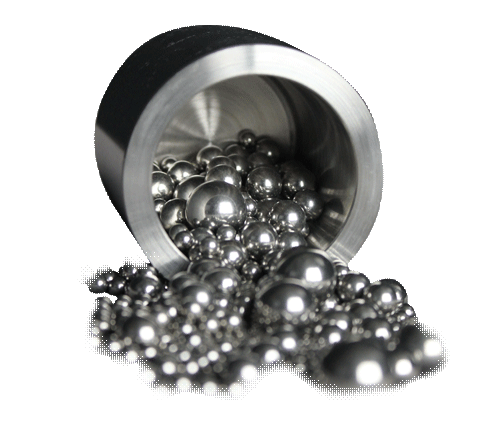
Grinding media are often chosen last: first, the mill, grinding bowl, speed and time are determined, and the balls are taken from those that are at hand. With this order, it is easy to obtain a result that is difficult to interpret: the powder is contaminated with the material of the balls, and it is no longer possible to separate the contribution of the impurity from the intrinsic properties of the sample. Where work is required in aqueous and mildly corrosive environments and it is important to limit iron transfer, it is often considered 304 stainless steel grinding balls. This is a consumable item, and not a part that serves the entire life of the installation, and it should be selected as carefully as the grinding mode.
Below we will look at what properties of 304 steel actually affect grinding, where the limits of its applicability lie, how the size and mass of the balls are related to the achieved fineness, and what information is needed for correct test grinding. A general list of areas of equipment and accessories is given at website TENCAN.
What problem do grinding media solve in a sample?
The grinding balls do not grind the material on their own - they transfer to the sample the energy stored by the moving parts of the installation. In a planetary, vibration or drum mill, this transmission occurs in two ways: through impact and through abrasion. The relationship between them is determined by the kinematics of the apparatus, the diameter and mass of the bodies, as well as the properties of the sample itself.
This leads to practical points that are often missed.
- Grinding media work in tandem with a specific glass or drum: not only their size and material are important, but also the geometry of the grinding chamber, fill factor and permissible load weight.
- Bodies wear out. Their mass and diameter vary from sample to sample, and the wear product gets into the sample.
- The hardness of the sample and the hardness of the bodies are not compared “by eye”: if the sample is harder than the material of the balls, the balls will wear out, and vice versa.
- Grinding and mixing are different operations. Intensive mixing of powder with bodies without sufficient impact energy will not result in grinding, even if visually the process looks active.
- The cleanability of a surface is as important as its hardness: a porous or damaged surface will retain the remains of the previous sample.
Hence the set of selection criteria: chemical compatibility with the sample and the medium, mechanical properties of the “ball-sample” pair, density, shape, size reproducibility from batch to batch and, finally, the ability to re-purchase the same material a year later, when the experiment needs to be repeated.
What does "304 stainless steel" mean in relation to grinding?
The designation “304” refers to the group of austenitic chromium-nickel stainless steels (in the European system - type 1.4301). Such steels are characterized by a chromium content of about 18% and nickel of about 8–10%; these values are provided as general reference data for the brand, and not as a passport for a specific batch of grinding media. It is chromium that forms a thin oxide film on the surface, which provides corrosion resistance in soft environments.
The austenitic structure means that the steel cannot be hardened by hardening in the same way as bearing and tool steels. It is strengthened by deformation: under impact and abrasive loading, the surface layer is hardened. For grinding media this property is dual. On the one hand, the riveted layer slightly increases wear resistance. On the other hand, strain hardening changes the magnetic properties of the surface and accumulates internal stresses, which eventually lead to chipping.
The density of this type of steel is approximately 7.9 g/cm³. This is less than tungsten carbide and close to the density of conventional structural steels. The practical consequence is simple: for the same diameter, a 304 steel ball carries less kinetic energy than a denser ball, and to achieve comparable impact requires either a larger diameter, a different speed, or a longer grinding time.
Corrosion resistance and its limits
The protective oxide film only works in environments where it can be restored. In aqueous environments without noticeable chloride content, 304 steel behaves quite stable, so wet grinding in water is one of the typical scenarios for its use. The situation changes in the presence of chlorides, with increased acidity or with the simultaneous action of abrasive wear and an aggressive environment: the film is constantly removed by friction, exposing fresh metal, and the corrosive contribution becomes noticeable.
Hence the rule: the ability to use 304 steel balls in a particular liquid is checked by the composition of that liquid, and not by the general consideration “stainless steel does not rust.” Data on acceptable media and delivery status (annealed or cold-hardened bodies) should be clarified with the supplier - standard reference information about the brand does not replace the product data sheet.
Magnetic properties and separation of balls from powder
Austenitic steel in the annealed state is usually weakly magnetic, and after strain hardening it can acquire noticeable magnetic susceptibility. This is important for the technique: you cannot count on the fact that ball fragments accidentally falling into the powder can be completely removed with an ordinary magnet. It is more reliable to use sifting through a sieve with a cell smaller than the minimum diameter of the bodies and visual control, as well as to keep track of the mass of the balls before and after grinding.
Wear of grinding media and transfer of impurities
The material of the grinding media is a source of impurities that operates constantly, and not only during an accident. The question is not whether the balls wear out, but what the wear rate is in a particular “sample-medium-mode” pair and whether it is acceptable for this task.
Wear Mechanisms
- Abrasive wear. If the sample particles are harder than the surface of the ball, they will shear the metal. For soft materials and moderately hard minerals the contribution of abrasive wear is less, for hard abrasives it is greater.
- Fatigue spalling. Repeated impacts accumulate defects in the surface layer, and scales can separate from the ball. Such particles are larger than abrasion products and are less well distributed throughout the volume.
- Adhesive setting. In some metal-to-metal pairs, material transfer with the formation of build-up is possible; in a powder medium, this mechanism more often manifests itself as the adhesion of a thin layer to the surface of the ball.
- Corrosion-erosive wear. In a liquid environment, friction constantly disrupts the passive film, accelerating the transition of the metal into solution and into sediment.
Why there is no “zero pollution”
The phrase “no contamination” does not apply to grinding in metal bodies. You can estimate the scale with a simple calculation example. Let 500 g of grinding media and 50 g of sample be loaded into a glass, that is, the ratio of the mass of the bodies to the mass of the powder is 10. If 0.1% of the mass of the balls is lost during the grinding cycle, this is 0.5 g of metal. Getting into 50 g of sample, this amount gives an increase of about 1% by weight. The values here are taken to illustrate the order of magnitude only; actual losses depend on the sample material, mode and environment and should be measured rather than assumed.
That is why the transfer of impurities is assessed experimentally: grinding is carried out without a sample or with an inert material and the result is compared with the sample, or elemental analysis is performed before and after grinding. Without such controls, any claims about product purity remain speculation.
What exactly goes into powder?
In the case of 304 steel, we are talking primarily about iron, but also trace amounts of chromium and nickel. For applications where these elements are undesirable, 304 steel is inferior to more inert materials - agate, zirconium dioxide, tungsten carbide - although they do not provide absolute purity. On the contrary, if the sample itself contains iron or if subsequent sample preparation involves the separation of the metal fraction, the contribution from the grinding media may be acceptable. The decision is made on the permissible content of specific elements, and not on a general principle.
Size, number and mass of balls: what determines the result
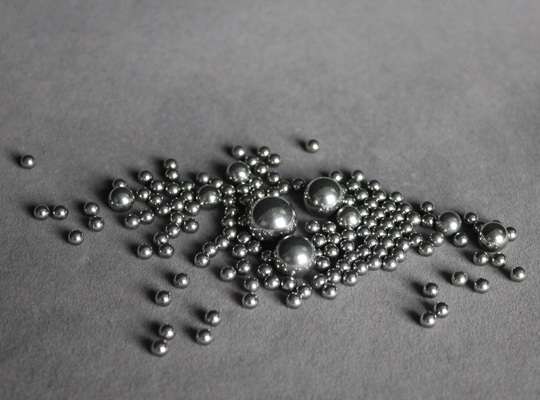
With the same ball material, large and small loads behave differently. Large bodies have more mass and deliver stronger blows; they are effective at breaking up relatively large particles but provide fewer contact points. Small bodies work more often for abrasion, provide a greater number of contacts and are better suited for bringing material to fine fractions, but their impact may not be enough to destroy durable aggregates.
It follows from this that the size of the bodies is chosen not according to the principle “the larger, the faster,” but based on the initial size of the sample and the target particle size distribution. In practice, a mixture of bodies of two or three sizes is often used so that impact destruction and abrasion are combined in one load. However, such a mixture complicates reproducibility: when preparing again, the same aspect ratio and the same total mass must be ensured again, otherwise the result will shift.
Separately, it is worth mentioning the number of balls. For a given load mass, increasing the diameter reduces the number of bodies, and vice versa. Therefore, two sets with the same mass but different diameters are two different modes, and not interchangeable options. If the experimental protocol records the mass of the load, the standard size should also be recorded.
Additional factors affecting the grinding result:
- filling factor of the grinding chamber - overload reduces the mobility of bodies, underload reduces the number of contacts;
- the ratio of body mass to sample mass, often referred to as BPR;
- distribution of bodies by diameter and diameter tolerance: variation in sizes from batch to batch changes the energy of the process;
- The shape of the bodies - a ball and a cylinder with the same mass - gives a different ratio of impact and abrasion.
Diameter tolerances, available sizes and delivery condition (for example, ground or polished bodies) are parameters for a specific catalog item. They should be taken from the documentation for the product, and not transferred from general considerations about the grade of steel.
Compatible with grinding bowl and mill
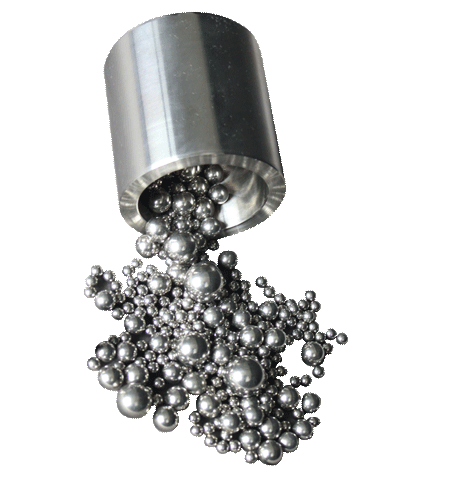
Grinding media are always paired with a grinding chamber, and this pair is evaluated as a whole. A useful rule: the materials in contact during grinding should not differ greatly in hardness and abrasive resistance, otherwise the softer element will wear out noticeably faster. If you place relatively soft bodies in a hard glass, the bodies will wear out faster; If solids get into the soft glass, chamber wear can be a major source of impurities.
Below is a qualitative comparison of common grinding media materials. The data serves as a guideline for choosing a direction and is not the passport characteristics of the products.
| Body material | Typical role | Basic restrictions |
|---|---|---|
| 304 stainless steel | Wet and dry grinding in soft media where the contribution of iron is acceptable | Relatively low hardness, sensitivity to chlorides, transfer of Fe, Cr, Ni |
| Zirconium dioxide | Tasks with increased cleanliness requirements | Higher cost, brittle under shock loads |
| Tungsten carbide | High density and hardness | High cost, own contribution of tungsten and cobalt to the product |
| Agate | Minimal metal input | Low density, load and temperature restrictions |
In addition to the materials, the geometric limitations of the apparatus are important: the maximum loading weight, the permissible diameter of the bodies, the volume of the cup and the design of the seals. Exceeding the permissible weight leads not only to accelerated wear, but also to overload of the drive. These parameters are specified for a specific mill model and cannot be transferred from one machine to another.
Equipment nearby does not mean compatibility
Sometimes devices from different functional categories are included in one purchase, and it is tempting to consider them parts of the same process. This is not true. For example, gas purification system for glove box ensures the maintenance of an atmosphere with a controlled content of oxygen and moisture, but it is not involved in grinding and does not affect the compatibility of the grinding media with the glass. If, after grinding, the sample requires work in an inert environment, the glove box with gas cleaning is a separate stage, and its parameters are selected according to the requirements for the sample, and not according to the characteristics of the mill. Likewise, a bead mill, a roller drum and a roller crusher are different devices with different principles of influencing the material, and the equipment of one of them does not automatically become suitable for the other.
Dry and wet grinding: how the environment affects wear
With dry grinding, the liquid does not remove heat and does not separate the particles. The abrasion product remains in powder, and fine fractions tend to stick to bodies and chamber walls. Adhesion reduces impact efficiency - some of the energy is wasted on the layer of material on the surface of the ball - and at the same time reduces abrasive contact. Oxidation of active powders in air may be another source of changes not related to mill operation.
During wet grinding, the liquid performs three functions: it removes heat, prevents the aggregation of fine particles and facilitates unloading. But it also changes the nature of wear. In a liquid medium, a corrosion factor is added to mechanical friction, and wear products partially pass into solution, from where they can be deposited on the sample particles. This does not make wet grinding worse - it’s just that the contribution of impurities is assessed differently than with dry grinding.
It is also important that the liquid must be compatible with two sides at once: with the sample and with the material of the bodies. Water, alcohols and other media have different effects on the passive film of 304 steel, so the issue is resolved separately for each media. Disagglomeration in a liquid medium and the destruction of primary particles are also different processes: liquid often helps to break up aggregates, but does not replace the mechanical energy necessary to reduce the size of the particles themselves.
Cleaning of grinding media and combating cross-contamination
Grinding media are reusable, and how their cleaning is organized depends no less than on their material. Cross-contamination between samples is especially dangerous because it is difficult to detect: traces of the previous sample are distributed throughout the new batch and can distort the analysis result.
The general principles of organizing work with bodies look like this:
- After unloading the sample, the body is freed from residues mechanically, so as not to damage the surface; abrasive treatment that changes the geometry of the ball is unacceptable, since it changes both the grinding mode and the contact area.
- Washing is carried out according to the manufacturer’s instructions and taking into account the properties of the sample; The choice of detergent and solvent is determined primarily by what needs to be removed and whether the surface of the bodies will react with this product.
- The bodies are dried and stored separately from other sizes and materials, in labeled containers. Mixing sets is a common cause of unreproducible results.
- The mass and diameter of the set are periodically monitored: a gradual change in these values is an objective sign of wear, more reliable than a visual assessment.
- For critical tasks, a blank experiment is carried out: grinding without a sample or with a obviously inert material in order to assess the background level of impurities from the bodies and the glass.
It is also worth considering the moment when the set is taken out of service. There is no single standard here: the criterion depends on the requirements for the purity of the product and on the permissible deviation of the regime. For one task, it is enough to replace the bodies when visible defects appear, for another - when the mass of the set deviates by several percent. In any case, it is better to fix the replacement rule in advance so that the decision is not made based on mood in the middle of a series of experiments.
From laboratory sample to larger batch
Transferring a regime from a laboratory beaker to a larger apparatus is rarely a simple matter of conversion. Formally, it is possible to maintain the ratio of the mass of the bodies and the mass of the sample, the fill factor and speed, but the energy distribution throughout the chamber volume will change: large installations have a different geometry of the loading movement, a different ratio of impact and abrasion, and different heat removal conditions.
A practical approach is not to scale everything at once, but rather in steps.:
- fix the standard size and material of the bodies, as well as the method of cleaning them, in order to exclude the influence of equipment on the comparison;
- maintain the body-to-sample mass ratio and filling, then check whether the particle size distribution is reproducible;
- check the process temperature and, if necessary, adjust the time, not just the speed;
- evaluate the wear of bodies in the new mode separately, since with a higher impact energy it may turn out to be higher than in the laboratory.
It is also important that as the batch increases, the absolute amount of metal transferred into the product increases, even if the relative wear rate has not changed. Therefore, the assessment of permissible contamination is carried out anew, and not transferred from a small volume. An additional factor is heterogeneity within a large batch: samples taken from different places may differ in the content of impurities, and this is also a subject of verification.
What to check before trial grinding
The quality of selection is largely determined by how fully the task is formulated. To make an informed choice of 304 steel grinding media, simply answer the following questions.
- Sample. Material, initial size, target size and method of measuring it, hardness, tendency to agglomerate, sensitivity to iron, chromium and nickel, permissible impurity content.
- Wednesday. Dry or wet grinding, liquid composition, presence of chlorides and acids, process temperature requirements.
- Equipment. Mill model, volume and material of the grinding chamber, maximum permissible loading weight, restrictions on the diameter of bodies.
- Mode. Planned mass of bodies and mass of the sample, size, speed, time, number of repetitions.
- Technological chain. How will the product be unloaded and sifted, is a protective atmosphere required, how is the cleaning of bodies between samples organized.
- Volume and repeatability. How much material needs to be obtained and how strictly the results must match between batches.
What makes sense to check specifically by testing, and not by calculation: the wear rate of bodies in a given “sample-medium” pair; actual content of metal impurities in the product; reproducibility of particle size distribution between replicates; behavior of the ball surface after several cycles. No preliminary assessment replaces these data.
Finally, about the limits of applicability: 304 stainless steel grinding balls are not a universal solution and not the “cleanest” option. It is a material with predictable behavior in soft environments, moderate cost and understandable limitations. If the task requires minimal transfer of metals, the choice should be towards more inert materials; If the iron contribution is acceptable, 304 steel remains a practical option, provided that wear is measured and cleaning is carried out systematically.