
The selection of grinding media begins not with the grade of steel, but with the requirements for the sample: what exactly needs to be obtained - the average size, the upper limit of the distribution of particles, the preservation of the structure, the absence of metal inclusions, or a simple reduction in size before the next stage. That's why 304 stainless steel grinding balls cannot be considered a universal solution for all problems. This is an option with specific advantages and no less specific limitations.
304 stainless steel is generally regarded as an austenitic chromium-nickel steel with good corrosion resistance and toughness. For grinding media this means the ability to withstand impact loads better than brittle ceramics and less risk of instantaneous ball failure. However, high viscosity does not equal high hardness: when grinding an abrasive powder, steel can wear faster than harder materials, and wear debris will end up in the sample.
The practical choice comes down to a trade-off between grinding energy, contamination and resource. Below are the conditions under which 304 balls give a predictable result, and situations where their use requires additional testing.
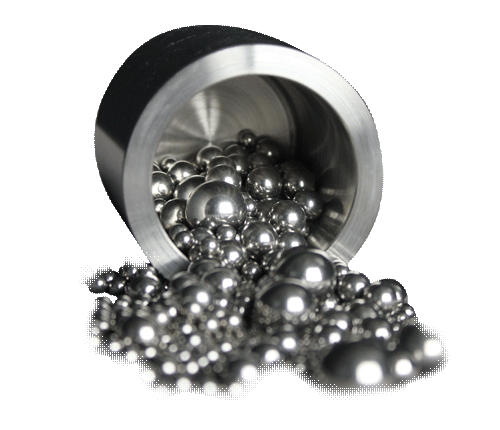
When are 304 balls appropriate and when do they create a new problem?
304 stainless steel balls are often considered for wet grinding in aqueous or neutral media, for applications where the mechanical strength of the grinding media is required and some amount of iron, chromium and nickel in the sample is acceptable. They are easy to handle, less prone to chipping than ceramics, and allow the use of magnetic separation to remove stray particles, as long as this does not conflict with the technique.
Restrictions begin where strict requirements are imposed on the purity of the product. There is no such thing as “zero pollution”: any material grinds itself. For 304, the only question is how large the wear contribution is and whether it is acceptable in a particular analysis. If the target product is sensitive to iron, chromium or nickel, even minor wear can be significant.
- Relevance increases for neutral aqueous suspensions, moderately abrasive materials and samples where metallic impurities are not limited.
- The risk increases for highly acidic, chloride-containing environments where localized corrosion is possible, and for high-hardness abrasive powders.
- Problems with magnetic materials are checked separately: steel should not be considered non-magnetic just by its brand name.
- Trace analysis requires a blank experiment and an assessment of the background, and not the assumption that “stainless steel does not pollute.”
It is important to distinguish between comminution, deagglomeration and mixing. If the goal is to break up aggregates or evenly distribute a component, high-energy grinding is not always required. Sometimes a soft mode is sufficient, but it must also be checked for compatibility with the material of the grinding media.
Finally, the 304 grade does not certify suitability for food or pharmaceutical applications. Such requirements are confirmed by documents for a specific product and operating conditions, and not just by the word “stainless” in the name.
What does grade 304 mean for grinding media?
304 steel is a common designation for stainless steel, but the choice of grinding media is not only about chemical composition, but also about surface condition, geometry, tolerances and batch repeatability. Two balls of the same nominal diameter may behave differently due to ovality, roughness, residual stresses and machining marks. Therefore, the product card is a starting point, and not a complete replacement for incoming control.
Surface, shape and size range
For consistent grinding you need a predictable geometry. Balls with burrs, dents or pronounced ovality roll worse, create an uneven load and wear out the lining faster. Surface contamination, traces of grease or previous processing must be removed before first use in a manner compatible with the material and application. The packaging cannot be assumed to guarantee surface cleanliness.
The size range and tolerances should be checked with the card and confirmed when ordering. Do not substitute the diameter “by analogy” with another supplier: seating, maximum load and mill mode may differ. If there is no specific meaning in the available materials, it should be requested rather than inferred from general reasoning.
Wear and corrosion go together
Dry grinding is dominated by abrasive wear, impact and heat. When wet, the corrosive effect of the environment is added to abrasive wear. Corrosion products may appear as discoloration of the suspension, but visual assessment is not a substitute for chemical analysis. You need to be especially careful when working with chloride solutions: for austenitic steels, local corrosion may develop unevenly, and its onset is difficult to notice.
Ball wear is not only a reduction in diameter. The shape, mass, roughness and size distribution of particles change. Over time, the grinding mode shifts, even if the mill settings remain the same. Therefore, for repeatable experiments, it is useful to record the batch number of the balls and the start date of use.
Don't choose 304 just because the material is "softer" or "harder" than another. It is necessary to take into account the hardness of the sample, its abrasiveness, the presence of liquid, temperature, grinding time and the permissible level of impurities. Mild steel paired with a soft specimen can contribute unexpectedly large amounts of adhesive bonding, while hard abrasive powder accelerates wear.
Grinding contamination: metal, oxides and residues
When the balls 304 come into contact with the sample, iron, chromium, nickel and other steel components, as well as oxides and corrosion products, can transfer into the sample. Some particles remain in the form of separate inclusions, while others dissolve in the liquid phase. Therefore, the question “how much contamination does a ball produce” does not have one number: it depends on the sample material, medium, time, grinding energy and surface condition.
It is necessary to separate the contribution of the grinding media from the contamination that was already in the original powder, in the glass, in the liquid or in the environment. If the sample shows an increased iron content, this does not yet prove the wear of the balls. The source may be the lining, lid, seal, sampling instrument, or insufficiently cleaned glassware.
How to evaluate the contribution of grinding media
A practical approach is a blank experiment with the same balls, glass and liquid, but without the powder under study or with an inert model of the sample, if this is permissible by the technique. Such an experiment does not prove the absence of contamination in a real sample, but helps to evaluate the background. Additional benefits include control of the original powder, analysis of the suspension after grinding, and visual inspection of the balls before and after.
For trace elements, visual inspection alone is not enough. If a product is specified for Fe, Cr, Ni or other metals, an analytical method with a suitable detection limit is required. Magnetic testing can help detect large metal particles, but it does not see dissolved ions or differentiate between sources. Don't use a magnet as your only proof of cleanliness.
If impurity levels are critical, 304 balls may not be a suitable choice even if corrosion resistance is good. In such cases, other grinding media materials are considered, but they also do not provide “zero” contamination: ceramics can chip, and harder materials can leave their own marks. The decision is made on the acceptable impurity profile, not on the advertising promise.
Ball size, loading and achievable fineness
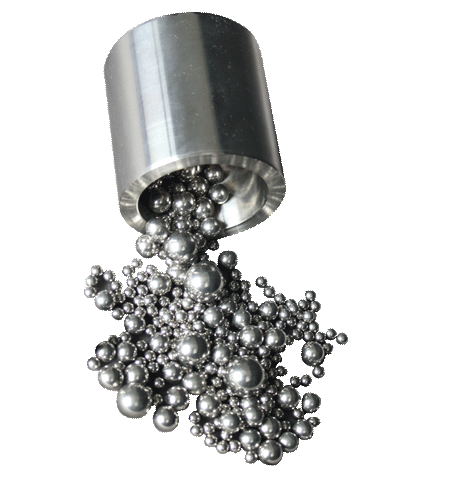
The diameter of the grinding media affects the impact energy and the number of contacts. Large balls produce stronger impacts and are better at breaking up large particles, but create fewer contacts per unit mass. Small balls increase the contact area and can speed up fine comminution, but may not have enough energy to break up tough aggregates. Therefore, the size is not assigned based on one target size value.
The result is also influenced by the mass of the load, the ratio of balls to sample, the free volume of the glass, the rotation speed, the medium and time. Do not confuse the volume of the glass, the total volume of grinding media, the working load and the mass of powder. Filling the glass “to the top” is not a universal recommendation: a specific mill and mode has its own acceptable range, which must be clarified in the manual.
| Protocol parameter | Why fix | What to indicate |
|---|---|---|
| Balloon material and batch | Relationship between the result and a specific product | Brand 304, batch number, start date |
| Diameter and shape | Impact on energy and contacts | Nominal size, tolerance, visual defects |
| Mass of balls | Load repeatability | Weighed mass, not just the number of balls |
| Sample weight | Relationship between medium and material | Weighing before and after grinding |
| Glass and lining | Possible contribution from neighboring parts | Material, volume, surface condition |
| Environment and mode | Effect on corrosion and heating | Dry or wet grinding, liquid, speed, time |
| Size measurement method | Comparability of results | Device, sample preparation, method for assessing distribution |
The achievable fineness depends on the starting material, its hardness and tendency to aggregate, as well as on the measurement. The typical minimum given for equipment or method is not guaranteed for any sample. For ductile materials, a significant portion of the work may be spent on deformation rather than destruction; for aggregating powders, the result without disagglomeration will appear larger.
If, after grinding, the particle size distribution has a second maximum or a long tail, this may be due to insufficient energy, overload, contamination or aggregation. Don't increase speed or time without checking temperature and wear: sometimes a softer setting with less load will give more repeatable results.
Compatible with mill, beaker and adjacent parts
The compatibility of grinding balls with a specific mill is not confirmed by the name of the material alone. It is necessary to check the permissible load weight, the internal volume of the bowl, the size and shape of the grinding media, the material of the lining, seals and cover, as well as the maximum speed. Steel is generally denser than many ceramic materials, so a load of the same volume may be heavier. This affects the load on the drive, heating and wear of parts.
Planetary, drum, vibration and bead mills differ in the nature of the impact. One installation is dominated by impact loads, while the other is dominated by shear and abrasion. A mode acceptable for large balls in a drum may be unacceptable for a small glass of a planetary mill. Do not transfer the parameters of one model to another just because they use balls of the same diameter.
Separately, it is worth mentioning mixing equipment. Three-dimensional mixer Designed for mixing, not grinding. Loading grinding balls into it does not convert the mixer into a ball mill and does not confirm compatibility with 304 balls. If the task is to average the powder, you need to select the mixer according to its own parameters, and not by analogy with grinding equipment.
Compatibility with the grinding bowl also includes a chemical aspect: the bowl material, gaskets and liquid can interact with the balls. For example, abrasive powder combined with a hard lining wears out both the balls and the cup faster. Sometimes the contamination comes not from the balls, but from the cap or seal that comes into contact with the slurry.
If the documentation for the mill does not directly indicate the permissibility of steel balls, consultation with the manufacturer or trial experience with monitoring of temperature, noise, vibration and condition of parts is required. Do not confirm compatibility based solely on a photograph or the fact that the balls physically fit into the glass.
Cleaning, storage and cross-contamination
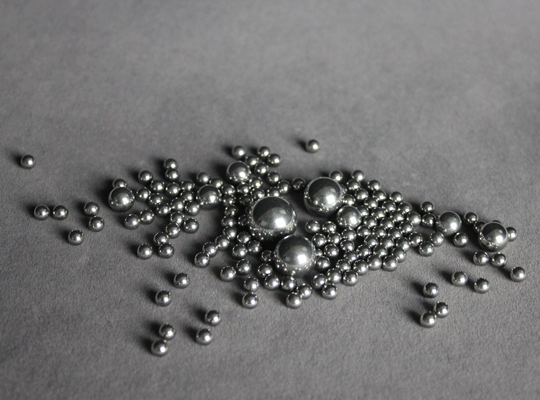
After grinding, sample particles, liquid and wear debris remain on the balls. The cleaning method depends on the previous material and the requirements for the next sample. First remove the bulk mechanically, then use a compatible solvent or detergent, rinse and dry. For 304 steel, prolonged contact with chloride solutions and aggressive acids should be avoided unless directed by the manufacturer as this may deteriorate the surface condition.
- Use separate ball sets for different material classes if cross-contamination is critical.
- Inspect the balls for dents, burrs, traces of corrosion and sample inclusions.
- Do not store the balls wet or leave them in contact with residual saline solutions.
- Record the cleaning procedure in a protocol so that the result can be reproduced.
- Check not only the balls, but also the beaker, lid, seal and sampling tool.
If the same mill is used for different materials, one wash may not be enough. Small particles are retained in microroughnesses and compactions, and the solvent can carry them into the next sample. In such cases, a dedicated set of consumables or at least separate marking of the sets helps.
Assessing cleanliness should not be limited to visual inspection. For sensitive analyses, washes from balls and beakers, blank grinding, and comparison with the original background are useful. If after cleaning stains appear on the surface or the color changes, this should not be considered a cosmetic defect: the reason may be corrosion or reagent residues.
It is better to remove damaged balls from work. Cracks, deep dents and pronounced ovality change the behavior and can increase wear. Do not try to restore the geometry of the ball by grinding without understanding the tolerances: this creates a new surface with unknown properties.
Trial grinding: minimum program and data for the supplier
Test grinding is not needed to “prove the quality of the balls”, but to check a specific combination: sample, mill, glass, medium and mode. Start with a short experiment in which only one parameter changes. Keep sample weight, ball weight, fluid, speed, and time the same if diameter or lot effects are being studied. Otherwise, the result cannot be interpreted.
- Record the initial particle size distribution and the moisture content or condition of the sample.
- Perform a blank experiment with spheres and medium without sample, if allowed by the procedure.
- Grind on a soft setting and check the heat, smell, color of the slurry and the condition of the balls.
- Compare two sizes or two loads without changing other conditions.
- Analyze the particle size and, if necessary, metal content of the sample.
- Inspect the balls, glass and seals after the experiment; record the observed changes.
To select a configuration, it is useful for the supplier to communicate the sample material, its initial size, target size and measurement method, acceptable impurities, beaker volume, mill model, maximum load, dry or wet grinding, fluid composition and cleaning requirements. If temperature or pressure restrictions are known, they are also indicated. The more specific the conditions, the less likely it is that the selected diameter or material will be unsuitable.
You should not ask for “the best balls” without describing the task. For one laboratory, the minimum size is important, for another - the absence of metal contamination, for a third - the resource and cost per kilogram of processed powder. These purposes may require different materials and modes. 304 balls are not a universal answer, but a tool with a scope.
Before purchasing, check the nominal diameter and tolerance, surface condition, lot number and available accompanying documents. If the card does not contain the required parameter, this is a reason to ask a question, rather than fill the gap with a guess. General information about the steel grade does not replace data on a specific product.
In the catalog TENCAN you can check the nomenclature and go to equipment cards: www.tencanballmills.com. For the main purpose of this article, the base point remains the card of 304 stainless steel grinding balls; parameters that are not included should be confirmed with the supplier before trial grinding. This approach reduces the risk of confusing the grade of material, mode, and expected purity of the product.