
Selecting grinding media for a laboratory ball mill often begins with a practical question: can 304 stainless steel balls be used to reduce sample contamination and achieve reproducible grinding results. There is no definite answer without experimental conditions. It is necessary to compare the sample material, type of mill and grinding bowl, acceptable wear, cleaning method and requirements for subsequent analysis. In the catalog TENCAN presented 304 stainless steel grinding balls; they should be considered as a specific type of grinding media and not as a generic replacement for ceramic, tungsten carbide or other material.
The practical difficulty is that the ball does not operate separately from the bowl, lid, seal and mill drive. Even the correct grade of steel will not compensate for incorrect loading, incompatible sizing, or insufficient cleaning. Therefore, the grinding task and acceptance criteria are first formulated, then the geometry and material of the equipment are checked, and after that a test grind is planned. This order makes it possible to separate the properties of grinding media from the influence of the regime and not attribute the properties of the entire system to one product.
Why the choice starts with the task, and not with the steel grade
The grade of material is important, but it does not describe the entire task. For one sample, the achievable particle size and size distribution are critical; for another, the integrity of the chemical composition; for a third, the absence of metallic inclusions or the ability to quickly clean the equipment between series. The same ball may be acceptable for coarse grinding of mineral powder but completely unsuitable for a sample where the content of iron, chromium or nickel is standardized. Therefore, before making a choice, they record what exactly will be considered pollution: a change in the elemental composition, the appearance of particles of another material, a change in color, or only an increase in ash content.
The second factor is the initial state of the sample. Coarseness, hardness, abrasiveness, stickiness, moisture and chemical reactivity affect wear and the behavior of the powder in the cup. Soft plastic material can stick to balls and walls, while hard abrasive powder will accelerate surface wear. For wet grinding, a medium is added: water, an organic solvent or a solution with a certain pH. The conclusion drawn for dry grinding of one batch cannot be transferred to wet grinding of another without verification.
The third factor is the analytical chain. If elemental analysis, magnetic separation, optical microscopy, or particle distribution measurements are planned after grinding, the purity and sample preparation requirements vary. Sometimes a laboratory blank experiment is enough to see the contribution of the equipment. Sometimes you need separate control of the source material and re-grinding without adding grinding media. They choose in advance which parameters will be compared, otherwise the result of the trial grinding is difficult to interpret.
Finally, the throughput of the entire laboratory operation is important, not just the mass of the balls. Grinding too long for the sake of fines increases wear and heat. Too short does not give the desired particle distribution. Selection of the mode is a compromise between size, purity, time and safety of the material. Specific values of time and load are established according to the methodology and equipment limitations; There is no universal recipe for all samples.
What does a ball of 304 give and where does its applicability end?
In the product card TENCAN The product listed is "304 Stainless Steel Grinding Balls". This means that the grinding body is made of 304 stainless steel. This does not equal a promise of chemical inertness in any environment, nor does it mean no wear. Stainless steel is a structural material that shows satisfactory durability in some conditions, but requires additional testing in others. For example, corrosive environments, chloride-containing solutions, strongly acidic or strongly alkaline conditions cannot be considered automatically safe for metal balls without manufacturer's data and testing.
For the laboratory, it is useful to separate three concepts: the material of the ball, the state of its surface and geometric characteristics. Mark 304 answers the first question only partially. Surface condition affects adhesion, cleaning and initial wear. Geometry—diameter, tolerance, shape—determines how the balls fill the cup and what gaps occur at the lid. If the current card does not show the available diameters, weight of one ball, tolerances or roughness requirements, this information should be clarified with the supplier, and not substitute a type series from another publication.
304 balls should be considered as metal grinding media for applications where their contribution to the sample is acceptable or controlled. They do not replace the lining and do not serve as a grinding bowl. They should not be confused with beads for a bead mill, with balls of a different composition, or with grinding bodies of a different geometry. The name “stainless” does not change the differences between batches and does not prove compatibility with a specific glass. Before ordering, check that the product is suitable in size and purpose, and not just by the name of the material.
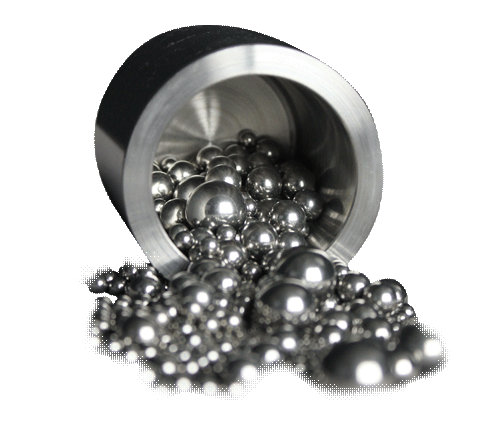
A separate issue is the expected grinding result. Metal balls can be convenient for preliminary grinding and for tasks where the minimum content of metal impurities is not standardized. But if the sample is intended to determine microquantities of elements that make up the steel, even slight wear can distort the result. In such cases, a blank experiment and, possibly, a different grinding media material are needed. You can't promise "zero pollution" just because the steel is called stainless.
Compatible with mill and grinding bowl
Compatibility starts with geometry. The diameter of the ball must correspond to the internal dimensions of the glass, the design of the lid and the allowable clearances. Excessively large bodies may place unwanted stress on the actuator, seal or cover; too small - do not provide the desired effect on the material and complicate separation from the sample. Please check the product data sheet for available diameters and recommendations for use. If this data is not available, it cannot be stated that a particular size is suitable for the existing mill.
Diameter, quantity and loading
The number of balls is related to their diameter and loading volume. The same mass with different diameters gives a different number of contacts and a different distribution of influences. However, this does not mean that a mixture of diameters is always better: mixing different bodies is a separate solution that needs to be tested. There is no one fill rate that is suitable for all glasses and materials. The limitations of the mill in terms of mass, volume and rotation speed are more important than the arbitrary number of balls. Exceeding the permissible load can lead to overheating, increased wear and damage to equipment.
When selecting the number of bodies, the mass of the sample is also taken into account. If there are too many balls relative to the sample, the proportion of friction and wear increases, and the useful volume decreases. If it is too little, the grinding takes longer and the result becomes less stable. For reproducibility, not only the mass of the balls is recorded, but also their number, diameter and method of placement. It is better to indicate all three parameters in the trial grinding protocol, otherwise repeating the experiment will be difficult.
Cup and lining material
A stainless steel glass and 304 balls are not automatically a “neutral” pairing. When two metal surfaces are in contact, wear contributions may be more difficult to separate and wear products may be more difficult to identify. A ceramic glass with metal balls also requires checking: different materials have different hardness and interact differently under impact and friction. You cannot choose a combination based solely on appearance or on the principle of “both products from the catalog.” Information is needed about the bowl material, lining, sealing and acceptable grinding media.
Separately check the cover, gaskets and unloading elements. Metal dust or small debris may accumulate in gaps and then end up in the next sample. If the glass has previously been used with a different material, rinsing alone may not be enough. For sensitive analyses, it is useful to have a separate set of equipment, or at least a separate set of balls, assigned to a specific sample type. This does not guarantee absence of contamination, but reduces the risk of cross-contamination.
Compatibility with a mill should not be declared solely by the name of the equipment series. Even if on the site TENCAN Different areas of powder preparation are presented; a specific mill, glass and grinding media must be checked according to the documentation. If there is no data on compatibility, the issue is resolved by a trial run with monitoring of temperature, noise, vibration and the condition of the equipment after grinding.
Wear and transfer of impurities
Wear of grinding media is a normal part of the process, but its acceptability depends on the application. The intensity of wear is influenced by the abrasiveness of the sample, the hardness of the particles, grinding time, exposure energy, the presence of liquid and the corrosiveness of the medium. For 304 balls, it is especially important not to confuse mechanical wear with corrosion. If the surface becomes dull, products of interaction with the environment or local changes appear, this may not only be abrasion. In such cases, work cannot be continued by referring to the “stainless” name; you need to assess the condition of the balls and the suitability of the environment.
Transfer of impurities can occur in several ways. The first is abrasion of the surface of the ball and the entry of metal particles into the powder. The second is the corrosive dissolution of alloy components in a liquid medium. The third is cross-contamination from a previous sample if cleaning is insufficient. The fourth is contamination from the cup, lid or seal, which is erroneously attributed to the balls. To understand the source, you need control: blank grinding without a sample, grinding with a sample and comparison with the source material. Without such a comparison, the specific cause of the pollution remains a guess.
One cannot claim that 304 balls are suitable for food, pharmaceutical or high purity applications without confirmation. In such areas, it is common to standardize not only the material, but also documentation, traceability, cleaning procedures and validation. The product catalog name does not replace these data. If minimal metal input is required, other materials should be considered and tested on the target sample. The choice of “stainless steel” in itself is not proof of the purity of the milled product.
Dry and wet grinding: different sources of risk
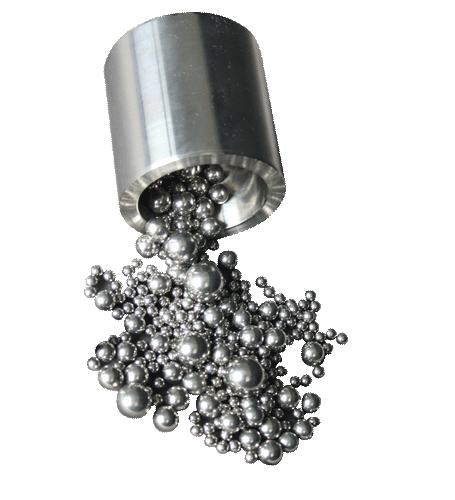
With dry grinding, the main issues relate to sticking, dust formation, heating and separation of balls from the finished powder. Soft or plastic materials can coat the surface of the balls, reducing grinding efficiency and making cleaning more difficult. Abrasive powder, on the contrary, wears out the metal faster. The heating of the cup is not equal to the temperature of each particle, but it can affect the properties of the material and the behavior of the seals. Conventional grinding should not be described as a cryogenic process unless liquid nitrogen cooling is provided and verified.
With wet grinding, interaction with the liquid is added to mechanical wear. Water, solvent or a solution with a certain pH can promote corrosion, leaching of wear debris and changes in particle aggregation. The fluid also carries small particles into the gaps and onto the lid, making cleaning more difficult. Liquid cannot be assumed to automatically reduce contamination: it may distribute wear debris throughout the sample and make it difficult to detect. For volatile or corrosive media, a separate assessment of material safety and compatibility is required.
The difference between dry and wet grinding is also important for choosing the size of the balls. In one mode, impact dominates, in the other, abrasion and dispersion. However, the exact ratio depends on the mill, speed, loading and slurry properties. There is no reason to transfer the result obtained on one test to another just because the material of the balls is the same. The trial grinding should repeat the intended mode: the same liquid, the same phase ratio and the same loading order.
Cleaning, storage and cross-contamination control
Cleaning the grinding media is part of the technique, and not a secondary operation. After grinding, the balls are separated from the powder and inspected for adhesion, corrosion and mechanical damage. Different materials require different procedures, but the general principle is the same: do not use aggressive or abrasive agents, which themselves change the surface and create new sources of contamination. If a solvent or detergent is used for cleaning, you must ensure that any residue is removed and does not affect the next sample.
Balls should not be stored together with other grinding media without labeling. Even visually similar products may have different compositions or different histories of use. For sensitive work, it is convenient to assign a separate set to a specific material or type of analysis. After cleaning, the balls are dried and inspected; Moist storage in closed containers may promote corrosion. If stains, rashes or traces of interaction with the environment appear on the surface, the question of further use is decided after inspection, and not based on external impressions.
Controlling cross contamination involves more than just balls. The glass, lid, gaskets and sampling tools are cleaned using the same logic. If the previous sample contained the element being determined, and the next one should be clean, a blank experiment with the same equipment materials is useful. It does not prove the absence of contamination under all conditions, but shows the contribution of a particular procedure. For batch work, it is best to have a written cleaning procedure and a note of which set of balls was used.
Test grinding and transition from one sample to a series
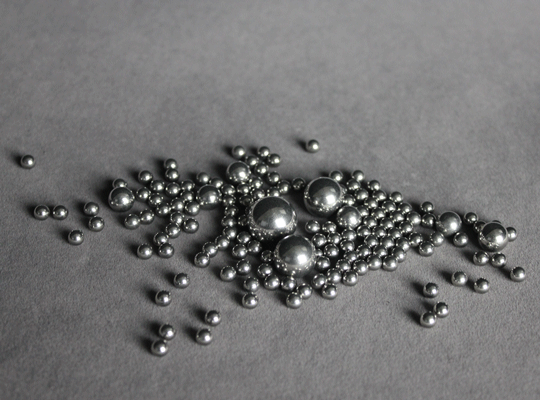
Test grinding is needed not to formally confirm the purchase, but to check a specific combination: sample material, glass, balls, mill and mode. Start with a small amount of material and record all the variables. If you immediately change the diameter of the balls, load, time and liquid, the result cannot be interpreted. It is better to conduct a short series with one variable parameter and a control blank experiment. For each point, not only the size is assessed, but also the condition of the equipment, temperature, material loss and signs of contamination.
It is useful to record the mass and number of balls, their diameter, beaker material, load volume, sample weight, ratio of material to grinding media, dry or wet mode, medium, time and mill settings in the protocol. If this data is not recorded, the reproduction of the experience becomes approximate. To compare lots, the same selection procedure and the same size measurement method are used. It is impossible to compare the results obtained by different methods and draw a conclusion about the superiority of the material.
| What to record | Why is this necessary? |
|---|---|
| Material and initial sample size | To separate the influence of the sample from the influence of the grinding media |
| Material, diameter and number of balls | For reproducible loading and wear assessment |
| Glass material and volume | To check compatibility and cross contamination |
| Dry or wet mode, environment | To assess corrosion, adhesion and particle distribution |
| Time, speed and heat | To understand energy impacts and limitations |
| Size and purity analysis method | To compare results correctly |
When moving to a larger batch, you cannot mechanically increase all proportions. First, check whether the ratio of material, balls and beaker volume is maintained, whether the mill can withstand the load and whether cleaning is not impaired. If an acceptable result is obtained on a laboratory sample, a separate batch may be required for scale-up. It is also important to consider that wear from prolonged grinding accumulates and can change the contamination profile. Therefore, for repetitive work, it is useful to periodically repeat the blank experiment.
Before ordering or trial grinding, it is worth informing the supplier about the type of mill, the material and volume of the beaker, the expected diameter and number of balls, sample properties, target mode, purity requirements and method of analysis. On the website TENCAN you can check the directions of the equipment and the product card, but specific compatibility is confirmed by documentation and testing. If there is not enough data for output, formulate the verification condition correctly, rather than choosing a value at random. This approach reduces the risk of error and maintains the connection between the technical solution and the actual sample preparation task.